





▲ Recommended
13 hrs
Desktop Immortal, developed and published by Lcc, is a quietly unconventional take on the idle genre, one that reimagines what it means to “play” a game by embedding itself directly into your daily computer routine. Rather than demanding your full attention in a dedicated window, it exists persistently on your desktop, behaving more like a living widget than a traditional application. This design choice immediately sets it apart, framing the experience less as something you sit down to engage with and more as a companion that grows alongside your everyday activity.
At the heart of the game is a cultivation system inspired by xianxia traditions, where a small on-screen character steadily trains, evolves, and ascends through various stages of power. What makes this system particularly interesting is how progression is tied to real-world interaction—specifically, your keyboard input. Every keystroke you make contributes to the character’s growth, transforming routine tasks like writing, browsing, or chatting into a form of in-game advancement. It’s a subtle but effective idea, one that taps into the satisfaction of productivity and reframes it as progress within a fictional framework. Even when you are not actively thinking about the game, it continues to move forward, reinforcing the sense that time spent on your computer is never entirely “wasted.”
The idle mechanics are deliberately forgiving and require minimal intervention. Resources accumulate passively, milestones are reached without constant supervision, and rewards arrive at a steady, predictable pace. Equipment drops and progression checkpoints provide small bursts of engagement, but they rarely demand strategic decision-making. Instead, the game leans into a relaxed rhythm, encouraging players to check in occasionally rather than remain constantly involved. This makes it particularly well-suited for multitasking environments, where attention is divided and gameplay needs to be unobtrusive.
As progression unfolds, the concept of “realm breakthroughs” becomes the primary marker of advancement, giving structure to what might otherwise feel like an endless incremental climb. These breakthroughs provide a sense of accomplishment and forward motion, even if the underlying mechanics remain relatively unchanged. There is also a light social component in the form of sects or player groups, which introduces a faint layer of communal interaction. While this feature adds some context and shared experience, it does not fundamentally alter the game’s solitary nature, serving more as a supplementary layer than a core system.
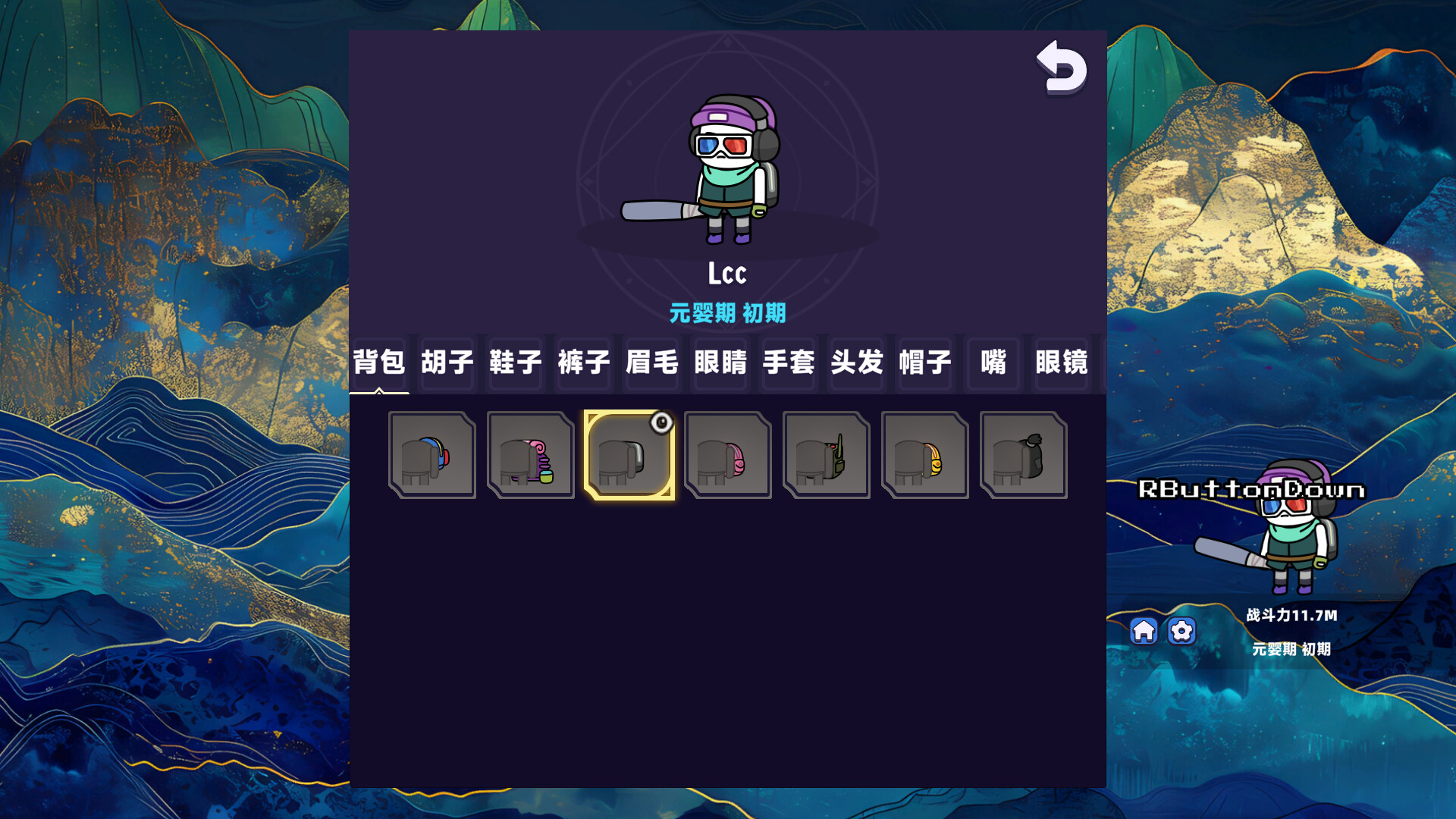
Visually, Desktop Immortal adopts a soft, minimalistic style that prioritizes clarity and unobtrusiveness over spectacle. The character design and interface elements are clean and inoffensive, blending easily into the desktop environment without becoming distracting. This aesthetic choice is crucial to the game’s identity—it succeeds precisely because it does not demand attention. However, this same restraint can also make the experience feel visually underwhelming, especially for players accustomed to more dynamic or visually rich idle games. The audio design follows a similar philosophy, remaining subdued and easily ignorable.
The game’s biggest strength—its passive, ever-present nature—is also where its limitations become most noticeable. Because it is designed to operate in the background, it rarely evolves into something deeper or more engaging. The systems, while conceptually clever, are relatively shallow, and the sense of progression can begin to feel repetitive once the novelty of the core idea wears off. There are few meaningful decisions to make, and little opportunity for players to influence outcomes beyond simply continuing to exist alongside the game. For some, this will be exactly the appeal; for others, it may quickly lead to disengagement.
Ultimately, Desktop Immortal feels like an experiment in redefining how games fit into daily life rather than an attempt to deliver a traditionally immersive experience. It succeeds in creating a low-effort, persistent loop that rewards time spent at the computer, and it does so with a certain quiet charm. However, its lack of depth and limited interactivity mean that it is unlikely to leave a lasting impression beyond its initial novelty. It is best approached as a background companion—something that enhances your routine in small, almost imperceptible ways—rather than a game that demands to be the center of your attention.
Rating: 6/10
At the heart of the game is a cultivation system inspired by xianxia traditions, where a small on-screen character steadily trains, evolves, and ascends through various stages of power. What makes this system particularly interesting is how progression is tied to real-world interaction—specifically, your keyboard input. Every keystroke you make contributes to the character’s growth, transforming routine tasks like writing, browsing, or chatting into a form of in-game advancement. It’s a subtle but effective idea, one that taps into the satisfaction of productivity and reframes it as progress within a fictional framework. Even when you are not actively thinking about the game, it continues to move forward, reinforcing the sense that time spent on your computer is never entirely “wasted.”
The idle mechanics are deliberately forgiving and require minimal intervention. Resources accumulate passively, milestones are reached without constant supervision, and rewards arrive at a steady, predictable pace. Equipment drops and progression checkpoints provide small bursts of engagement, but they rarely demand strategic decision-making. Instead, the game leans into a relaxed rhythm, encouraging players to check in occasionally rather than remain constantly involved. This makes it particularly well-suited for multitasking environments, where attention is divided and gameplay needs to be unobtrusive.
As progression unfolds, the concept of “realm breakthroughs” becomes the primary marker of advancement, giving structure to what might otherwise feel like an endless incremental climb. These breakthroughs provide a sense of accomplishment and forward motion, even if the underlying mechanics remain relatively unchanged. There is also a light social component in the form of sects or player groups, which introduces a faint layer of communal interaction. While this feature adds some context and shared experience, it does not fundamentally alter the game’s solitary nature, serving more as a supplementary layer than a core system.
Visually, Desktop Immortal adopts a soft, minimalistic style that prioritizes clarity and unobtrusiveness over spectacle. The character design and interface elements are clean and inoffensive, blending easily into the desktop environment without becoming distracting. This aesthetic choice is crucial to the game’s identity—it succeeds precisely because it does not demand attention. However, this same restraint can also make the experience feel visually underwhelming, especially for players accustomed to more dynamic or visually rich idle games. The audio design follows a similar philosophy, remaining subdued and easily ignorable.
The game’s biggest strength—its passive, ever-present nature—is also where its limitations become most noticeable. Because it is designed to operate in the background, it rarely evolves into something deeper or more engaging. The systems, while conceptually clever, are relatively shallow, and the sense of progression can begin to feel repetitive once the novelty of the core idea wears off. There are few meaningful decisions to make, and little opportunity for players to influence outcomes beyond simply continuing to exist alongside the game. For some, this will be exactly the appeal; for others, it may quickly lead to disengagement.
Ultimately, Desktop Immortal feels like an experiment in redefining how games fit into daily life rather than an attempt to deliver a traditionally immersive experience. It succeeds in creating a low-effort, persistent loop that rewards time spent at the computer, and it does so with a certain quiet charm. However, its lack of depth and limited interactivity mean that it is unlikely to leave a lasting impression beyond its initial novelty. It is best approached as a background companion—something that enhances your routine in small, almost imperceptible ways—rather than a game that demands to be the center of your attention.
Rating: 6/10
1 found helpful
Steam ↗