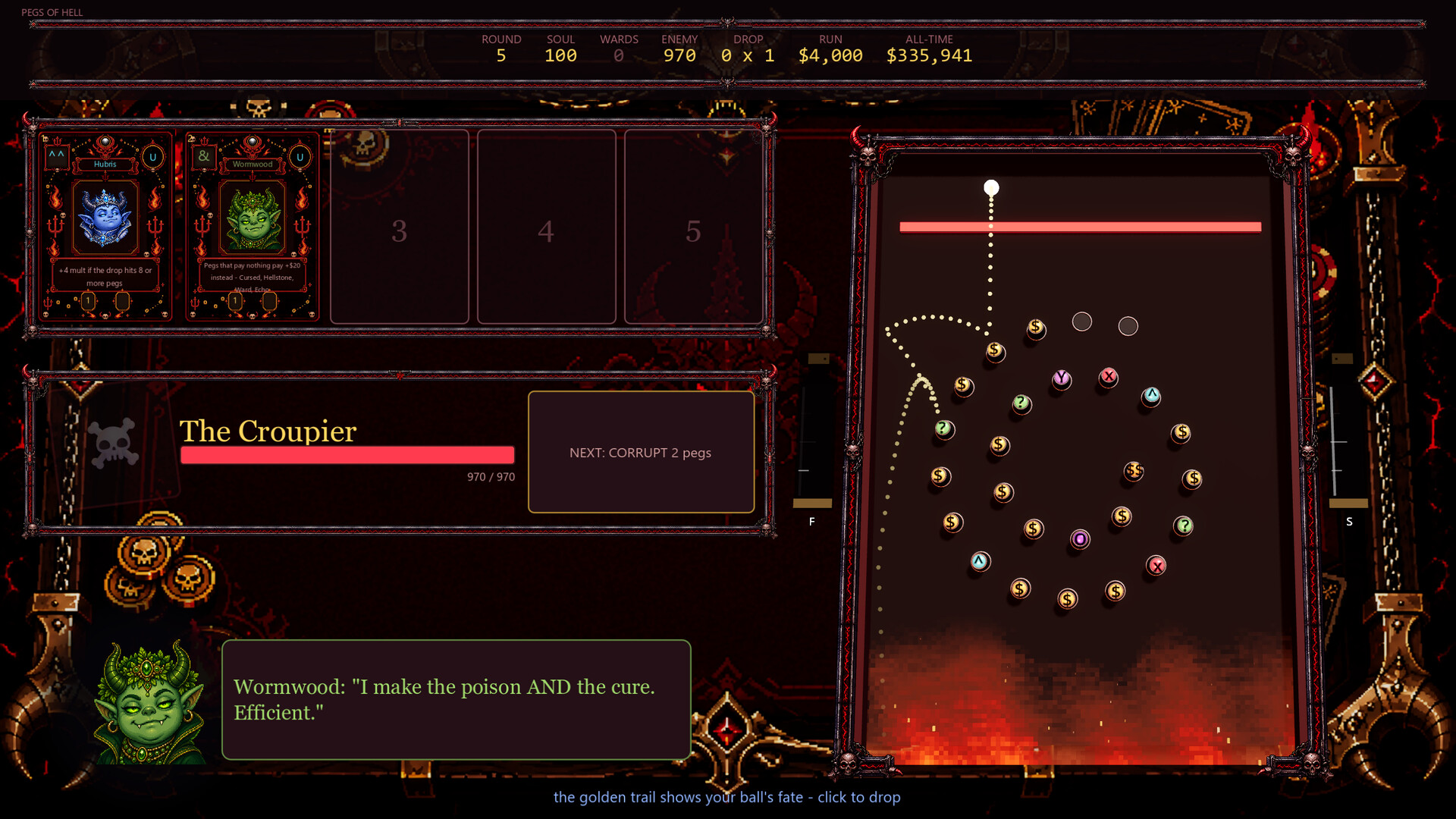
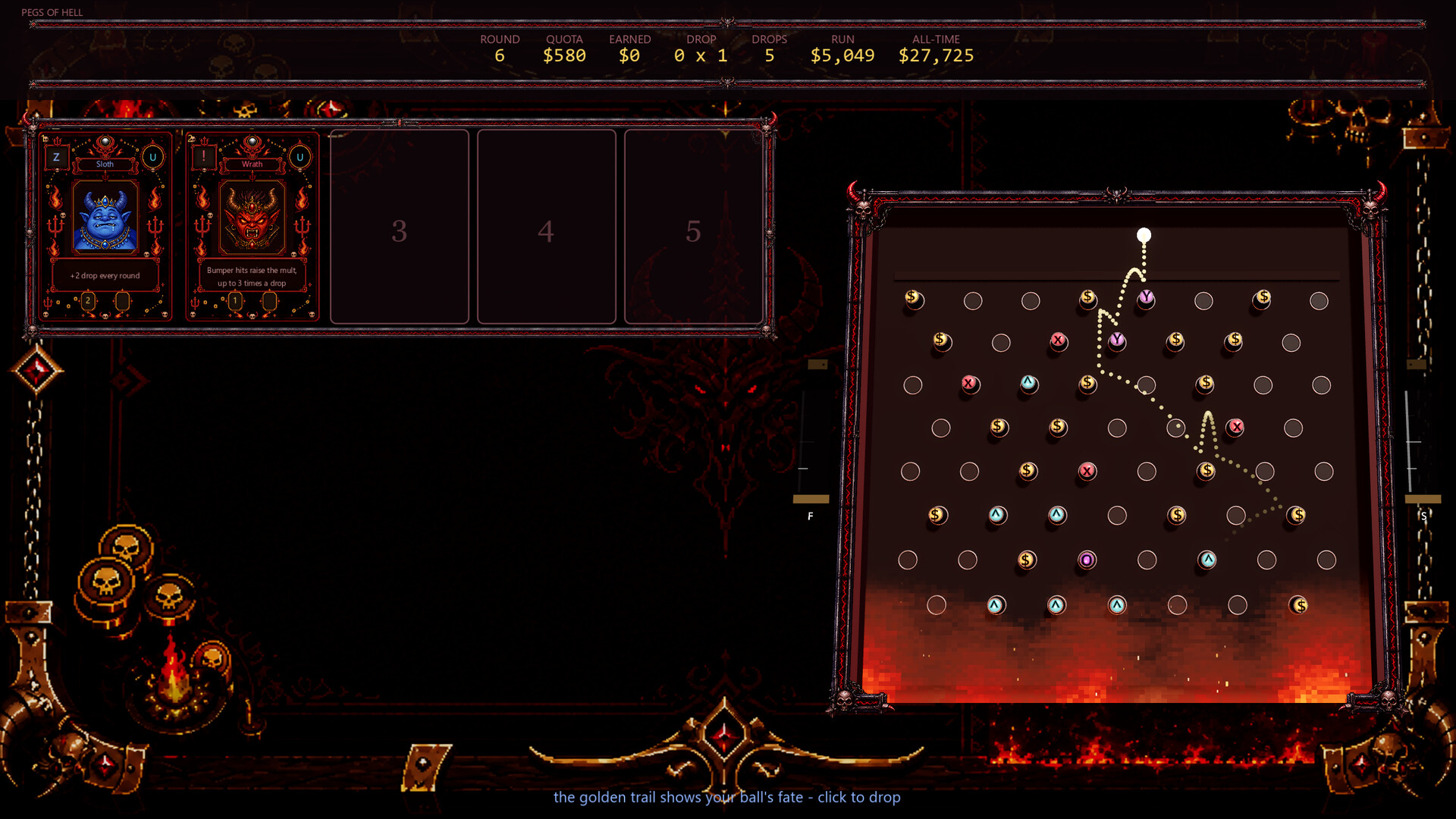
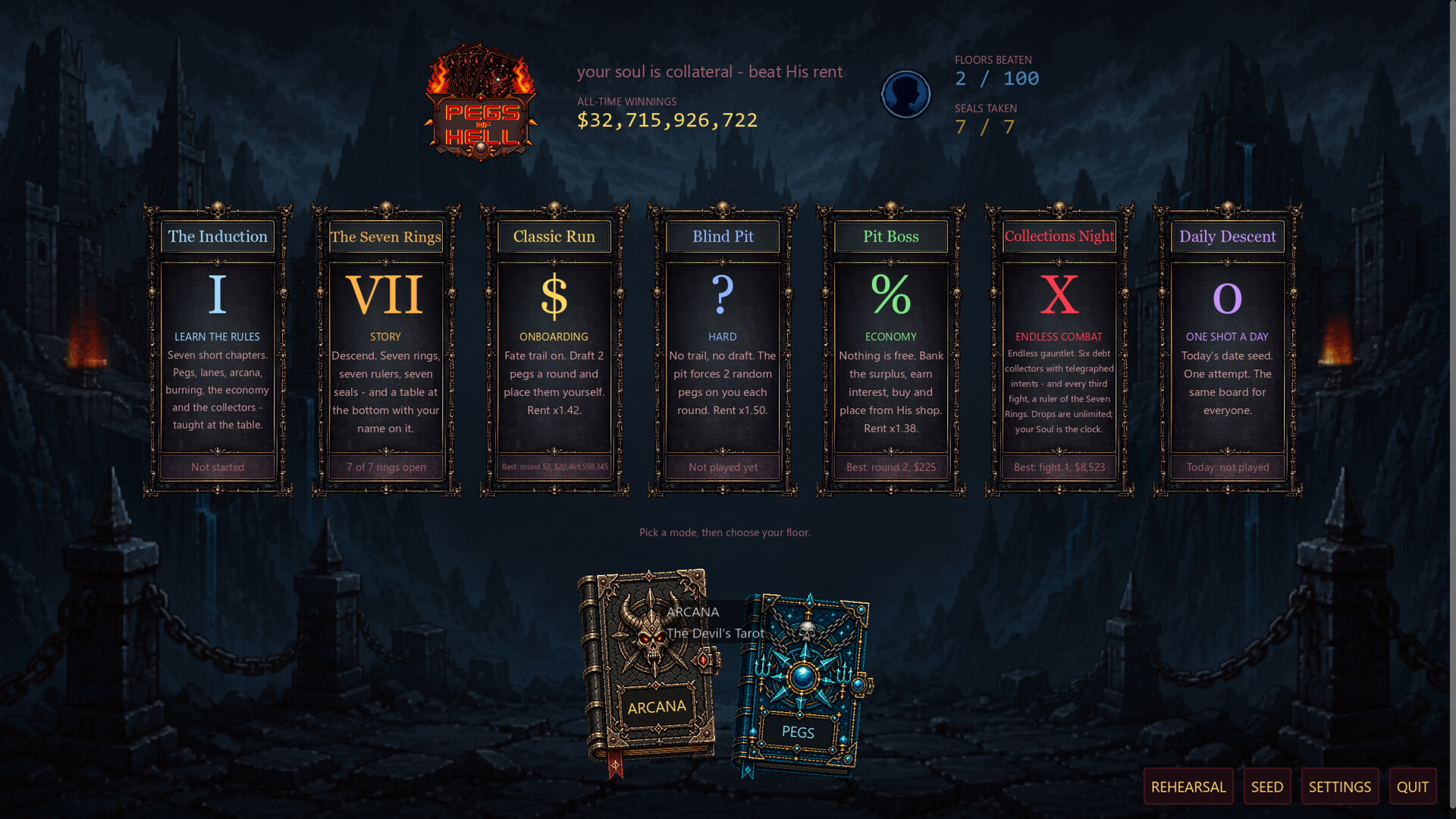
Pegs of Hell combines roguelike progression with dynamic pachinko construction. You design the board itself by placing and upgrading pegs, deploying magical Arcana, and chaining elemental effects to rack up massive scores before time runs out. It's ideal for players who enjoy building systems and watching physics-driven chaos unfold across multiple runs.
About this game
A physics roguelike where you build the pachinko board yourself. Place and upgrade pegs, arrange powerful Arcana, split balls, trigger elemental chains and create absurd scoring machines before Hell's rent catches up with you.
Players, last 90 days
Peak 0 · Low 0
Daily peak concurrent players, sampled once a night from Steam.
The casino is open. The Devil expects his rent.After seven months of development, we’re excited to share Pegs of Hell, available now on Steam!Imagine the bouncing-ball chaos of Peggle meeting the combo-building strategy of Balatro, in a casino run by someone you really don’t want to owe money to.Every drop is a chance to turn your choices into a spectacular payout. Build combinations of pegs and Arcana cards, improve their abilities, and watch the ball put your strategy to the test. Just remember: a good round doesn’t mean the Devil is finished collecting.What awaits you at the table?Physics-driven gameplay: Plan your drop, then watch the ball bounce through the possibilities you’ve built.Pegs, upgrades and Arcana: Connect their effects to create increasingly powerful combinations.A casino with a dark sense of humour: Meet its strange cast and try to stay ahead of the rent.Your choice of presentation: Explore different visual styles, adjust voiceovers separately, or enable AI-free mode for the Symbols presentation with AI-generated voices muted.Thank you to everyone who tested the game, shared feedback, challenged our decisions and helped us improve it. We’ve spent a lot of time building and connecting these systems, and we can’t wait to see what combinations you discover.If you encounter a problem or have a suggestion, please let us know in the Steam discussions. We’d love to hear how your runs go.Take your seat. Make your first drop. Try not to disappoint the landlord.The Wombex Games team
We’d like to share a little about how Pegs of Hell was made, where AI helped, and the work behind the game.Seven months of developmentPegs of Hell began with a question: could we combine the physics-driven fun of Peggle with the combinations and strategic decisions we love in games like Balatro?Finding a satisfying answer took a lot of experimentation. We spent time working out which layers of complexity belonged in the game, how its systems could interact, and how to give players meaningful choices without losing the simple pleasure of watching a ball bounce through the board.Around three months went into the prototype alone. That meant building systems, connecting them, testing ideas that didn’t always work, and finding a reasonable starting balance.The hell setting came from our love of dark humour and the possibilities it offered for presenting those mechanics. A devil collecting rent felt like a fitting host for this particular casino. We also considered a science-fiction setting, and we still like that idea enough that we might revisit it someday.Where AI fits into the artworkWe explored several approaches to the visual design. Our early drawings felt too flat, and we struggled to bring the colours and drawing style together in a way that suited the game.We then used our pencil drawings as starting points for AI-assisted artwork, developing them into different visual styles. Those styles are available in the finished game, so players can choose the presentation they prefer.AI was part of that process, and we want to be clear about it. It helped us explore and produce artwork, while selecting, revising and integrating those assets remained a substantial part of development.The talking heads involved another series of experiments, including plenty of attempts that didn’t work. We ultimately used 3D models with facial rigs because they gave us control over expressions, facial movement and head motion.VoiceoversOur original plan was to present dialogue through tex...
Posts come from Steam's official announcements feed.