

▼ Not recommended
272 hrs
The early access version of this game that won Best Incremental Browser Game of 2021 is substantially more fun than the 1.0 release. As of the time of writing, you can play the early access version (0.5.4) for free on itch or by right clicking the game in your library > Properties > Game Versions & Betas > select v0.5. I do not recommend purchasing the 1.0 release for the current price ($12 USD).
The changes between the early access version and the 1.0 release are focused on slowing down the player's rate of progression and removing the number of tools that the player can use to solve problems. In order to try to force each run to feel unique (something which I am doubtful was achieved), the developer greatly reduced the amount of content that can be accessed in a single playthrough of the game. These changes are in service to a prestige system that most casual players will never interface with, either because one 40 hour run was enough or because they already dropped the game out of frustration.
Detrimental changes:
- Almost all of your spells, glyphs, artifacts, alchemy recipes, and rituals are randomly drawn from a pool. The number of times you can draw from this pool is small and you will not be able to get everything on a single run, limiting the number of tools available to you. For example: you cannot rely on using alchemy to ameliorate a poor wood production, as you may never roll the alchemical recipe to transmute wood.
- Attributes now take roughly 2 seconds to develop after clicking. In a game in which the primary action you take is purchasing attributes (the achievement for purchasing 100,000 attributes is one of the most commonly completed), this adds up to a substantial and unnecessary slowdown.
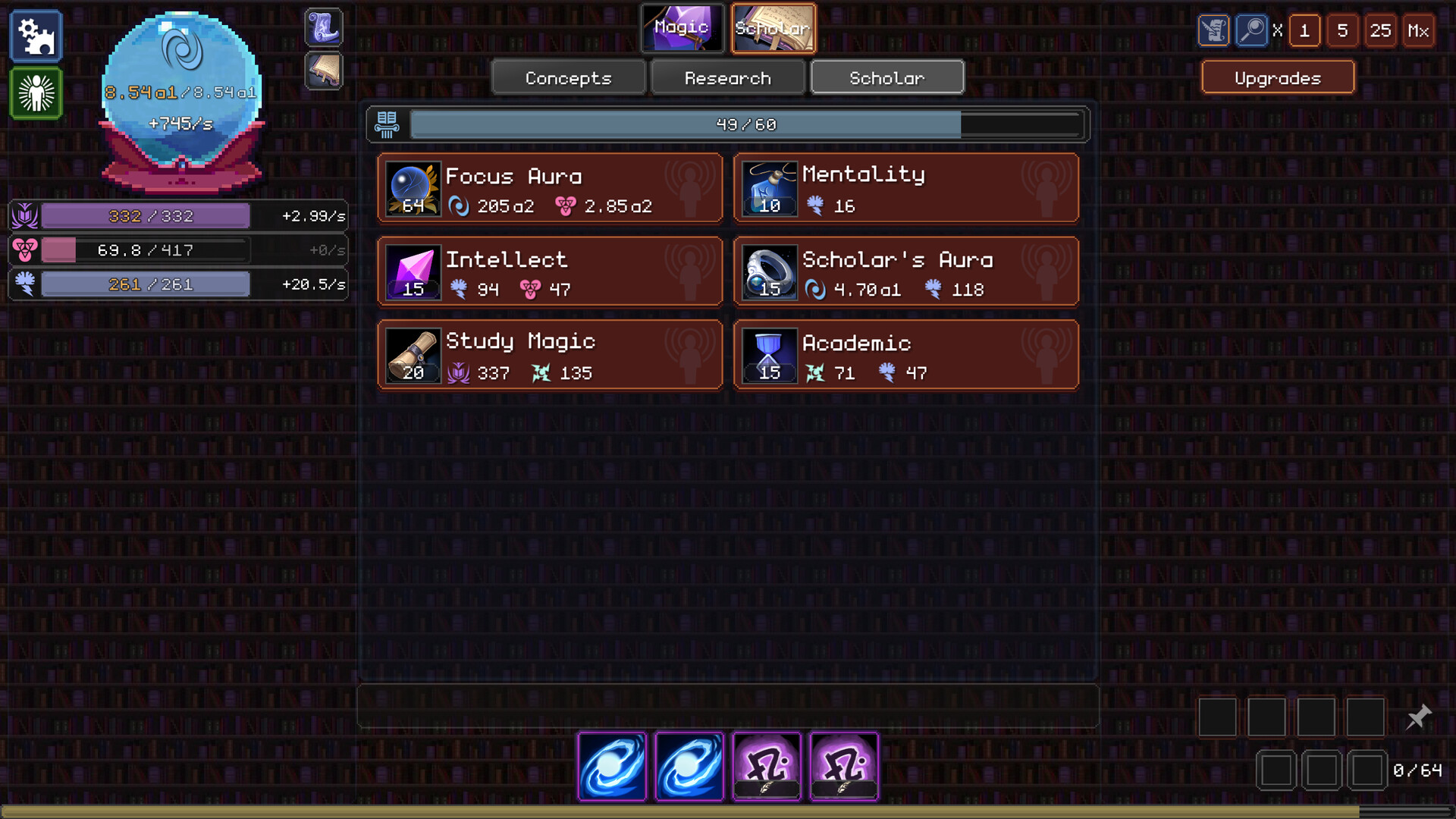
- Researches now require advancement points, which are awarded every few hundred attributes purchased. You will not be able to get the majority of researches on a first playthrough, as opposed to the early access version in which you could develop all of them with enough time. There is no ability to reset and reinvest your advancement points, meaning that the only solutions to a poor distribution of researches are to power through a slowdown of 10+ hours or to restart your save. A first run of this game will take 30-40 hours if you interrogate every tooltip-within-tooltip for hidden mechanics, 40-50 hours for the casual player, and 50+ hours if you invest your advancement points in researches that look fun rather than researches that strictly help you alleviate production chokepoints.
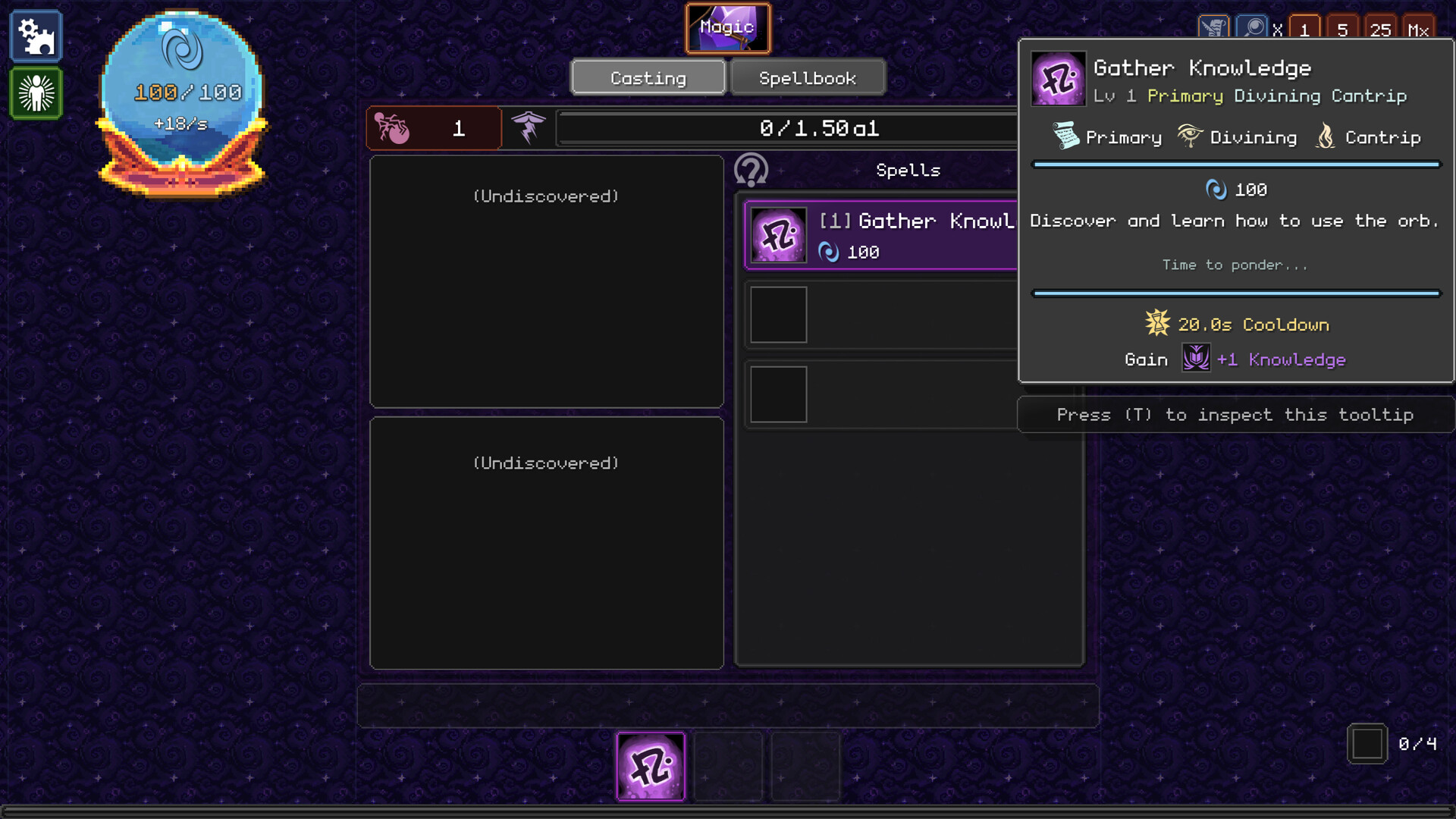
- You can no longer set the levels of your spells (which determines their costs) individually. Rather, there is a single global variable that determines the level of all spells on all loadouts. I found myself constantly navigating back to the wizardry screen to fiddle with the global output level, as I needed to adjust it nearly every time I switched loadouts and sometimes even between different spells on the same loadout. In a similar vein, druidry and alchemy also have a single variable that determines their costs and outputs. I found myself adjusting the druidry output level every time I had to switch types of plants that I was harvesting.
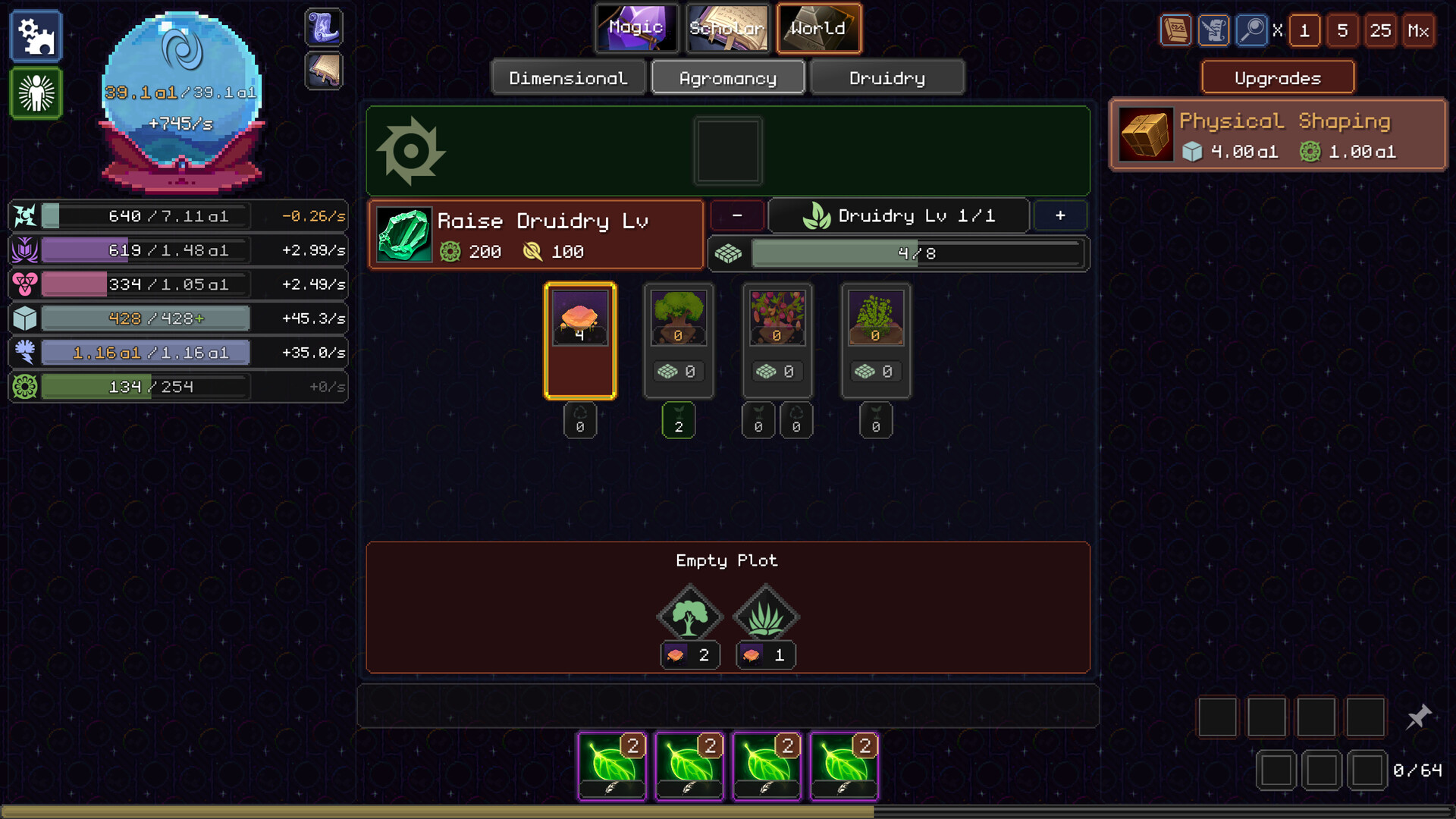
- Progression is gated behind a new mechanic called agromancy, which requires real life time waiting for plants to grow. Unless you heavily invest your very limited advancement points into druidry, you will often find your chokepoint to be waiting for plants.
- Crafting is no longer instantaneous, and there is a heavy penalty for crafting large quantities at once. This incentivizes a playstyle of clicking the crafting buttons once every 15 seconds, waiting, and doing it again to avoid the bulk crafting penalty.
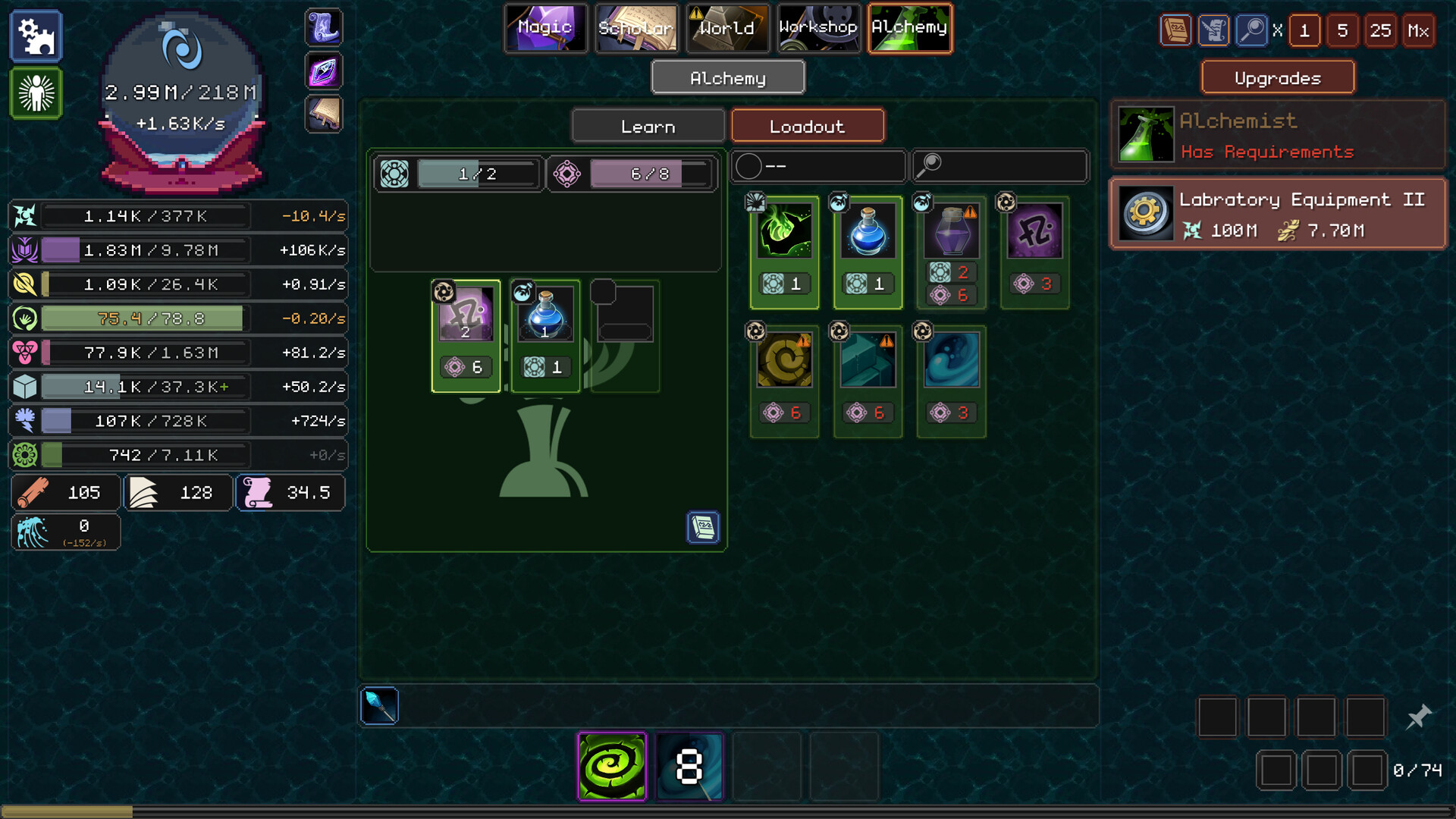
- Alchemy has been cut down, with the number of recipes you can have active at once greatly reduced. Instead of long, carefully-balanced production chains of resources, now you can typically only bulk-produce one or two resources at a time. As you progress, nearly every alchemy-exclusive resource is moved to an aura attribute that produces it without the need for alchemy at all.
- Individual researches rarely feel like substantial power boosts, though they can be powerful in aggregate. In the early-access version, each research gave you immediate access to new tools and mechanics.
- The prestige system does not feel rewarding. My first prestige run was about 25% more powerful than my first run, which was noticeable but not exciting. You can expect to earn roughly 6 of the game's 50 achievements on a first run. Each prestige run beyond that point will earn another 2-3.
- This may be a matter of personal preference, but I find the 1.0 version to have a worse ui layout than the early access version.
Overall, an extremely disappointing experience with the 1.0 version from someone who loved the early access version.
The changes between the early access version and the 1.0 release are focused on slowing down the player's rate of progression and removing the number of tools that the player can use to solve problems. In order to try to force each run to feel unique (something which I am doubtful was achieved), the developer greatly reduced the amount of content that can be accessed in a single playthrough of the game. These changes are in service to a prestige system that most casual players will never interface with, either because one 40 hour run was enough or because they already dropped the game out of frustration.
Detrimental changes:
- Almost all of your spells, glyphs, artifacts, alchemy recipes, and rituals are randomly drawn from a pool. The number of times you can draw from this pool is small and you will not be able to get everything on a single run, limiting the number of tools available to you. For example: you cannot rely on using alchemy to ameliorate a poor wood production, as you may never roll the alchemical recipe to transmute wood.
- Attributes now take roughly 2 seconds to develop after clicking. In a game in which the primary action you take is purchasing attributes (the achievement for purchasing 100,000 attributes is one of the most commonly completed), this adds up to a substantial and unnecessary slowdown.
- Researches now require advancement points, which are awarded every few hundred attributes purchased. You will not be able to get the majority of researches on a first playthrough, as opposed to the early access version in which you could develop all of them with enough time. There is no ability to reset and reinvest your advancement points, meaning that the only solutions to a poor distribution of researches are to power through a slowdown of 10+ hours or to restart your save. A first run of this game will take 30-40 hours if you interrogate every tooltip-within-tooltip for hidden mechanics, 40-50 hours for the casual player, and 50+ hours if you invest your advancement points in researches that look fun rather than researches that strictly help you alleviate production chokepoints.
- You can no longer set the levels of your spells (which determines their costs) individually. Rather, there is a single global variable that determines the level of all spells on all loadouts. I found myself constantly navigating back to the wizardry screen to fiddle with the global output level, as I needed to adjust it nearly every time I switched loadouts and sometimes even between different spells on the same loadout. In a similar vein, druidry and alchemy also have a single variable that determines their costs and outputs. I found myself adjusting the druidry output level every time I had to switch types of plants that I was harvesting.
- Progression is gated behind a new mechanic called agromancy, which requires real life time waiting for plants to grow. Unless you heavily invest your very limited advancement points into druidry, you will often find your chokepoint to be waiting for plants.
- Crafting is no longer instantaneous, and there is a heavy penalty for crafting large quantities at once. This incentivizes a playstyle of clicking the crafting buttons once every 15 seconds, waiting, and doing it again to avoid the bulk crafting penalty.
- Alchemy has been cut down, with the number of recipes you can have active at once greatly reduced. Instead of long, carefully-balanced production chains of resources, now you can typically only bulk-produce one or two resources at a time. As you progress, nearly every alchemy-exclusive resource is moved to an aura attribute that produces it without the need for alchemy at all.
- Individual researches rarely feel like substantial power boosts, though they can be powerful in aggregate. In the early-access version, each research gave you immediate access to new tools and mechanics.
- The prestige system does not feel rewarding. My first prestige run was about 25% more powerful than my first run, which was noticeable but not exciting. You can expect to earn roughly 6 of the game's 50 achievements on a first run. Each prestige run beyond that point will earn another 2-3.
- This may be a matter of personal preference, but I find the 1.0 version to have a worse ui layout than the early access version.
Overall, an extremely disappointing experience with the 1.0 version from someone who loved the early access version.
191 found helpful
Steam ↗