▼ Not recommended
3 hrs
A spiritual successor that lacks spirit
The original Majesty was one of my most played games as a kid. I easily sank hundreds of hours into it, and over a hundred more as an adult with the Steam remaster. It was a game full of charm and quirks and just the right amount of challenge, and to this day I still never get bored of playing it.
I've long wished for a spiritual successor to the Majesty series. The sequel, Majesty 2, didn't hit quite the same mark as the original. A few games here and there have come close in their own ways, but none have captured the entirety of the Majesty spirit.
I'm sorry to say that though Lessaria has most of the form of Majesty (and even the same Advisor voice actor as the original - the inimitable George Ledoux), it is lacking the spirit that made the original so compelling. Including demo time I'm 7 hours in and about halfway through the campaign missions, but I've already lost interest in continuing.
My interest is surely not helped by a lack of sandbox mode; DESPITE what the store page claims, there is no sandbox mode - just a single endless survival mode set on one static map layout. If you, like me, derived most of your playtime in Majesty's sandbox mode, you will be immensely disappointed.
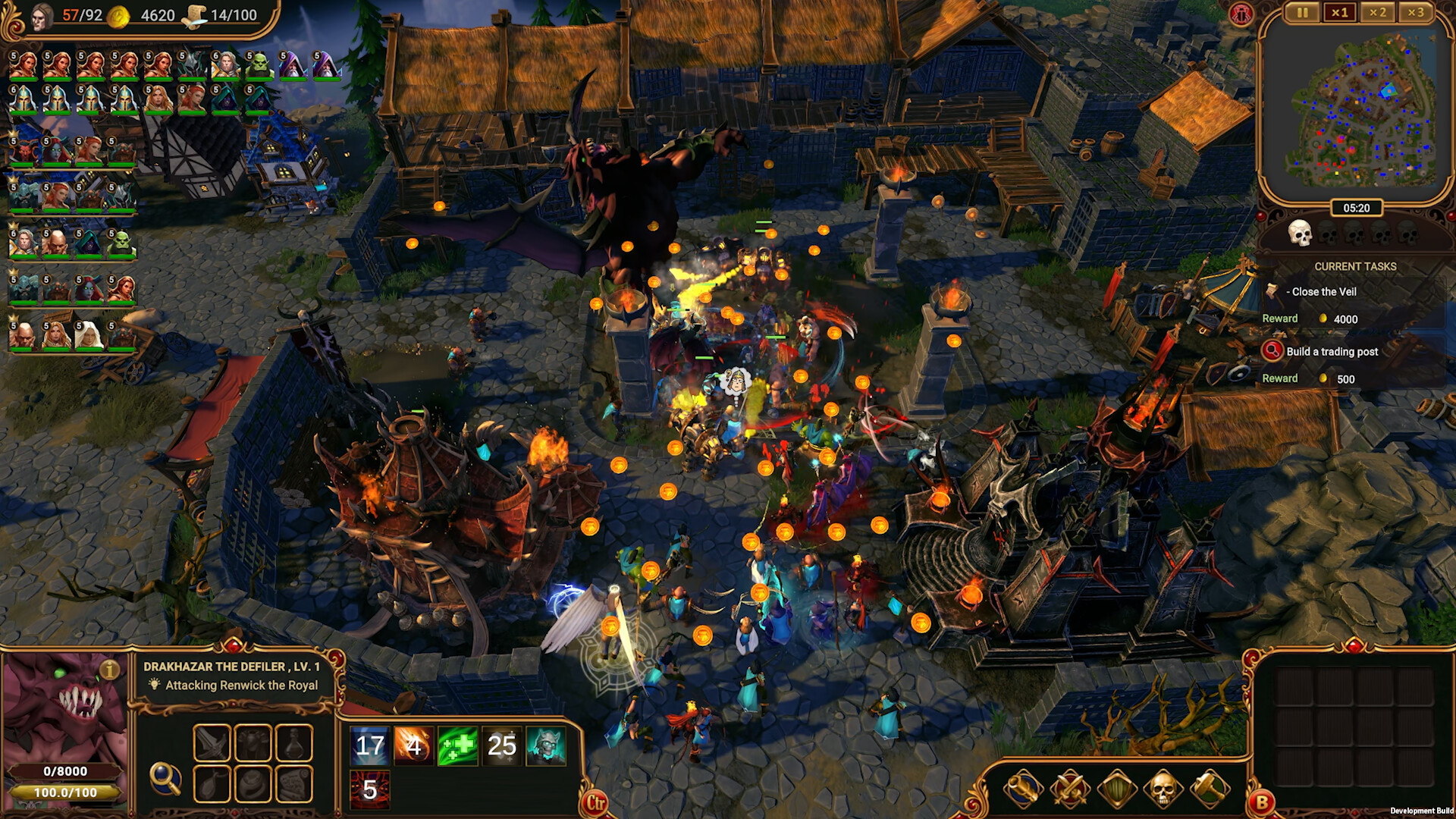
Mechanically, Lessaria is an indirect control RTS like the original Majesty. You have control over building placement (in this case on a visible grid) and upgrades, and hero recruitment, but your heroes act on their own volition - choosing to explore, or fight, or shop, or flee, with some classes tending toward certain behaviors (e.g. Rangers like to explore, and Rogues are more easily motivated by coin). Like in Majesty 2's expanded flag system, you can entice heroes toward certain actions with bounties to Explore, Attack, Defend, and Avoid, and Lessaria is very transparent about which heroes find your price suitable, eliminating the guesswork of how large of a bounty is sufficient.
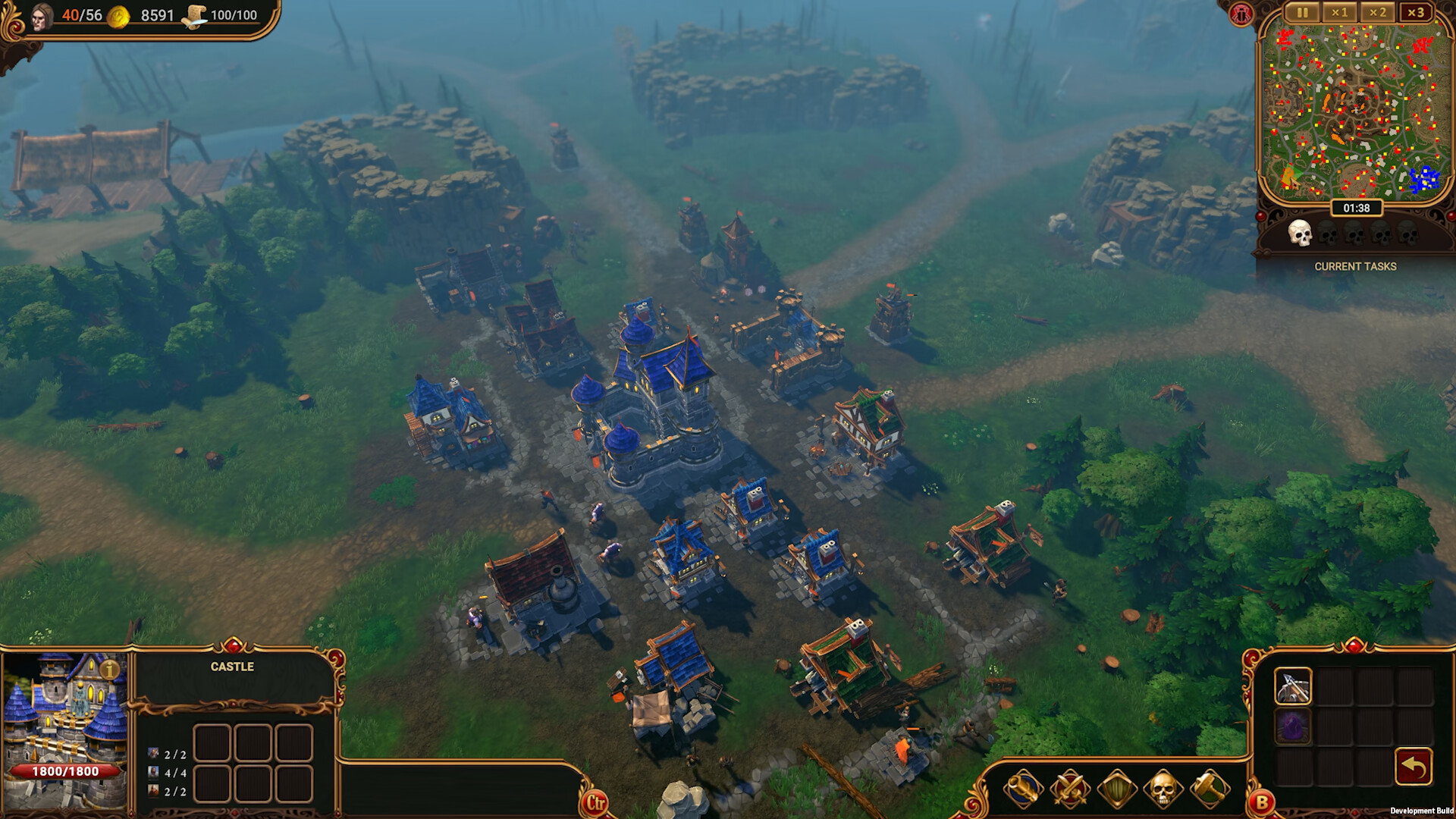
As mentioned, kingdom building takes place on a grid, so you can more easily see where a building can be placed. However, Lessaria limits your building area to a relatively small portion of the overall map, beyond which you can never expand - with the exception of trading posts, which must be placed on specific (sometimes hard to spot) pre-set locations, like in Majesty 2. This means your ability to exert map control with defensive structures is much more limited, and your heroes will be wandering far afield from the relative safety of your base.
Lessaria addresses this distance problem with a portal system - for a small sum of gold, you can build a portal structure in your city and permanently link it to several pre-placed portal sites across the map (once you've scouted them), allowing your heroes to instantaneously travel to and from far-flung locations. It's a good solution, and generally the portal sites are well-placed on Lessaria's hand-crafted (not randomized) maps.
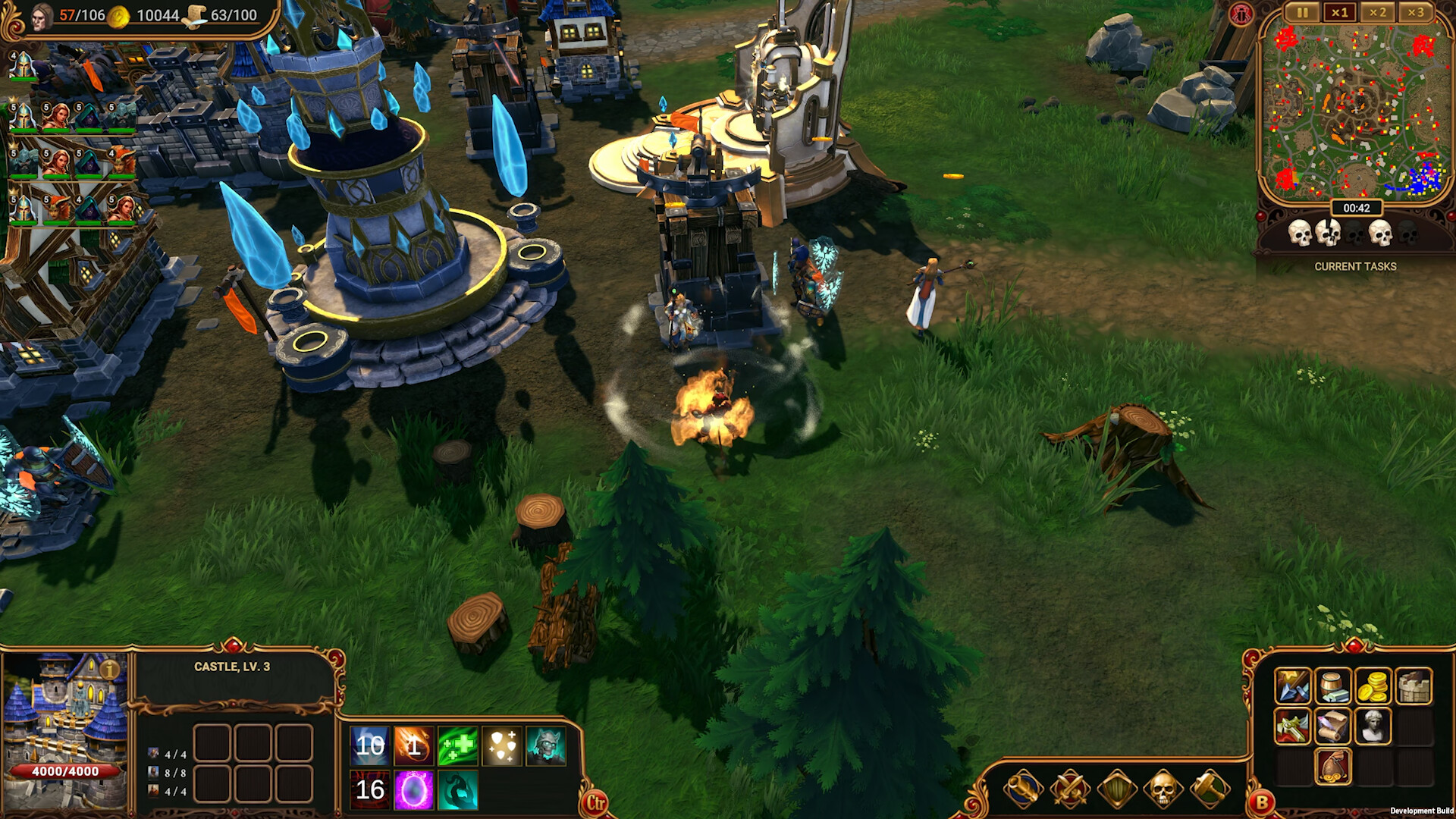
Beyond the hard limit of space constraints, Lessaria imposes a softer limit on what you're able to accomplish through a new resource: population. As your city expands, you will need to (manually, as opposed to automatically in the Majesty series) build peasant homes. These contribute population (and tax income), which are spent to recruit heroes (refunded when the hero dies) and to build certain economic structures. At certain thresholds of population your overall gold income gets reduced, making it harder to expand beyond a certain point. You won't be able to build a grand kingdom here as you delay pursuing your objective to let gold accumulate, and you won't be able to recruit more than perhaps two dozen heroes total.
Speaking of delays, Lessaria adds one other mechanic to ensure the player can't take things easy. Waves of monsters will attack your kingdom on a set timer, with a wave strength rating of 1-5. Each successive wave will increase in strength, with the upper end being strong existential threats that can quickly wipe out your kingdom. The wave strength is reduced every time you destroy a monster den - but these dens are limited in number, and the waves are not. If your heroes are overzealous and destroy the dens too quickly, you will have no way to mitigate the strength of the assaults for the rest of your mission. And a lack of dens will not affect the strength of the assault - assault waves spawn out of thin air, with no regard for how many (if any) monster dens remain. This effectively imposes a timer on every scenario in the game, and encourages the player to counter-intuitively preserve monster dens until they are needed to reduce the strength of the assault wave, in order to buy enough time to accomplish the scenario objectives to win.
Finally, and perhaps most disappointingly, your units just lack personality. There's no cries when a unit dies ("I'm mellllllltinnnnnng!"), and in fact death happens so quietly I often don't notice until I click a guild and see an opening. Units have very few voice quips, which you only hear when selecting them, or when zoomed in far enough to hear them during a fight (the sound mixing on the game needs some polish). There's no jaunty cries of "tax collector!", or building animations when, say, the tavern or blacksmith are being visited by a hero. All those little audio and visual details that gave the original Majesty its charm and humor are missing here.
In summary, Lessaria is a spiritual successor that lacks the spirit that made the original Majesty so good. It tries some mechanical tweaks to the formula with mixed success. It bears evidence of systems that were tried and either abandoned or never expanded on (resource gathering, random hero personality traits that affect their stats but can't be interacted with). There are several places lacking polish (audio mixing, mismatched written and spoken dialogue, typos). And it completely lacks the sandbox the store page claims it has, and which gave the original Majesty such longevity (for me at least).
If you're a fan of the original Majesty and craving something to scratch that itch, I can't say Lessaria will do so. It didn't for me. Maybe come back after a few more patches, for additional polish, balancing, and hopefully an actual sandbox mode.
453 found helpful
Steam ↗
▼ Not recommended
15 hrs
Eight years ago "Dusk" was released. It was a game that pioneered a boomer shooter genre - shooters, that were trying to mimic gameplay of original Doom, Quake and other 90th and early 2000th shooters. They had less of a focus on narrative, immersion, storytelling, realism, all of which was sacrificed in favor of high speed gameplay. But they weren't just replicating what was good, they were also trying to enchance it, mixing modern ideas with an old genre. Some were adding roguelike and looter shooter elements, some where adding style points from DMC, some where adding level up systems and weapon upgrades, some where exploring what you can do on an old engine with a modern hardware and so on. Point is, they were improving upon what was.
Lessaria is trying to do a simmilar thing for it's obvious inspiraction - Majesty, yet looking at it, I struggle to name one thing that it does better. On the contrary, most things are way worse.
Heroes, the most important part of Majesty, lack any personality or interactions. In your first level game tells you that Warriors like to patrol and Rangers like to scout, remaining 14 heroes are ether do nothing specific or copy one of the above. When in original magesty some heroes synergised with other ones, like Barbarians would protect Rangers, or Cultists would plant poison plants that Thieves can collect, none of this is in this game.
You can only choose your aliement once, between Good, Evil or Neutral, down from two and a half in Majecty, where you could choose between Order and Chaos, Sun and Moon worshipers, or ignore all of them and go with Barbarians, all of which offered you different aproach to the gameplay depending on what you were interested in mixing and matching. Here three main fractions are all following the same beat of Frontline fighter - mage with healing ability - strong unit with AoE. Good is a bit more tankier, Evil is a bit more damage oriented, Neutral adds more control, but they all kinda feel the same.
Then, there are non-human heroes. In Majesty allying yourself with Elves, Dwarves or Gnomes provided you both benefits and drawbacks. Gnomes were cheap, would help you with building and repairs, but were weak and randomly spawned their own buildings, which contributed toward creation of sewers. Elves would boost your economy, providing your marketplaces with more profit and performing at tavernas, but would build Casinos, which you could not tax and which would drain money from your followers without giving much in return to you. Dwarves would provide you with extra defensive buildings, but were rather expansive to make, compared to the other two. None of the stated above mechanics are in this game. Choosing between Orcs, Elves and Dwarves just give you a different unit, nothing else.
Hero progression is equialy screwed. In original Majesty abilites of heroes were tied to their level. Cultists were not able to turn into bears until they're level 7, Wizards weren't able to teleport until they're level 4 (and hence were an easy prey to even a common rat), Necromancers were not able to take control over the undead until they're level 8. This made your high level heroes way more important to equip and maintain. Here, all skill can be used even by level 1 heroes, provided you learn them first in their guild, and, if you have a training field, most heroes would rush straing to it right after their recruitment to train to level 5. After getting to level 5, most would get to level 7 by fighting enemies, and get stuck there, no matter what's happening. I've seen a hero getting to level 10 naturally once, and I don't think he was much stronger then level 5 that I recruited 2 minutes ago. Main problem of heroes dying here isn't that you're losing an important unit, but that you'll have to pay a fee for their recruitment again.
Speaking of economy, it also sucks. In Majesty their was a beutiful circle of capitalism, where you would invest in your heroes, they would travel and aquier riches, that they would spend back in your shops for gear, potion and buffs, fueling your economy. Here, although some of this systems are still relevant, majority of your profits comes from a Lumbermill, Quarry or Foundry which generates money semi-passively, as long as there are enough of corresponding resource around. Heroes buying stuff doesn't generate you that much profit, which is honestly a shame.
Creating parties, a key mechanic from Majesty 2, here straight up makes your heroes worse. Following heroes will often neglect their training and shoping, in favor of following their leader. You're paying money, and often quite a large summs of them, to make your heores weaker.
Missions also kinda feel the same. Some have a timer, some restrict you in what units you can recruit, but all ends up with fighting some sort of a generic boss, most of which are not immune to CC, and hence spend majority of the fight stunned.
Visually, it looks worse the a game from 2000. It may have more pixels on screen, but instead of a beutiful fantasy style of the original, there's a brownish blob of something on your screen. Why is "fantasy kingdom simulator" looks so grey and bland I have no idea. Most monster lairs blend together with their enviroment, Both heroes and monsters look kinda boring, not to mention that due to zoomed out camera they're way to small. Music is forgettable, so is voice acting.
Multiplayer also isn't here.
In the end I'm left with a question: "Why is it here?". What does Lessaria have, that Majesty didn't do better 25 years ago? And I honestly can't name one thing that it does.
143 found helpful
Steam ↗
▼ Not recommended
11 hrs
TL;DR -> Tries to be Majesty, but never gets further than copypasting some of the buildings and units. Mediocre RTS (gets quite grindy), literaly in the first third of the game you get almost all techs and stuff and from there it just becomes rinse-repeat. I would be more lenient if the devs wouldn't claim to be the successor of Majesty, but they did claim. Blame is on them, I guess.
Wall of text
Let me give you three reasons why I loved Majesty.
1.) Tavern (and stuff)
If somebody didn't play Majesty, hard to understand what the Tavern meant there. Trolls could literally beat your tax collectors to pulp and take their money, destroy your castle, do almost everything, but heroes couldn't care less. Sometimes they did (had some tendencies to protect their own faction building), but usually didn't, unless you provided monetary incentive. However, when the aforementioned trolls finished violating and looting my tax collector and turned on to destroy the tavern, almost all heroes jumped at them. Even rushed from the other corner of the map to protect the beloved, sacred place. Funnily enough, it was the most effective defense building too, as heroes protected at all costs. After all, that was the place they retreated to after a hard day and pissed away some of their money. That building caused so much emergent events and funny scenarios that it's unbelievable. Not only tavern doesn't matter here (generates some income, plus you can form parties -> more on that later), those funny emergent moments and hilarious events are gone. Bland, soulless RTS.
2.) Hero personalities, synergies and stuff (which literally nonexistent in this game)
Apart of the funny events heroes generated, they had some preferencies, even rivalries between races. Elf race hated dwarfs, but performed in taverns and increased the revenue there. Increased your marketplace income too, but automatically came with Elven Lounge, which was literally a gambling den. Your heroes made willpower check and the ones who failed literally became gambling addicts for a while. They disappeared in the lounge and, became kinda unavailable for a while and pissed away all of their money (seriously, how cool is that?!). And yes, THAT money you aimed for, but more on that later.
See, none of these funny things are in this game. Even worse, hero levels don't really matter here. Honestly, if you research a skill, certain heroes will use it. Low level wizards hurl meteor shower and so on. Stupid. In Majesty skill was tied to level, which made high-level heroes super valuable and important.
3.) Speaking of THAT money, the core economics here is just broken
So in Majesty the wilderness was full of endless riches. But you didn't have units, henceforth you needed your heroes to loot those treasures and you cleverly stripped them of wealth by providing amenities they needed. Or didn't. Who cares, you just wanted their money to achieve your goals.
Well, none of that is here. First and foremost in Lessaria your primary income comes from taxing peasant houses and building quarries, lumberyards, whatever. Relying on heroes as primary income is pretty much gone, you just spam economical buildings and profit (literally).
HOWEVER (capital letters) bounty system is ♥♥♥♥♥♥ up here as well. In Majesty legendary heroes wanted legendary bounties. Getting a super-high level party motivated literally cost like half of your treasury. Or more. Here a few hundred golds was enough to mobilize like almost all of my heroes. Never had to spend more than 500, because if it may not have been enough (it was, almost all the time), reinforce the order with a royal decree and done. Gone are the moments where you juggle between having enough buffer in your treasury to place flags/orders versus if you should build more stuff. Heroes just automatically attack all enemies they see, so basically they clear up the map themselves.
106 found helpful
Steam ↗
Reviews are by Steam users, hosted on Steam.