Back to rankings
A Game About Getting Bigger

A Game About Getting Bigger

by PcZ Games

★ 89%
Price N/A
Avg Players 0
Reviews 18
Released Jul 22, 2026
CasualGod GameIdlerIncremental
View on Steam ↗

Media

Video
Screenshot
Screenshot
Screenshot
Screenshot
Screenshot
Screenshot
Screenshot

Feed a black hole by destroying planets and asteroids in this loot-driven incremental. Watch your cosmic consumer expand across the screen as you gather resources and unlock upgrades, making each destruction more powerful than the last. Ideal for players who enjoy straightforward progression loops and the satisfaction of watching numbers climb.

About this game

Players, last 30 days

Peak 0 · Low 0

Daily peak concurrent players, sampled once a night from Steam.

What players are saying

▲ Recommended 0 hrs
This one is very simple and doesn’t come with much content. It doesn’t even belong in the incremental genre because there’s no upgrade tree at all, although there is still a sense of progression. The core gameplay revolves around a black hole in the middle of the screen that sucks up debris from space objects you destroy by moving a circle over them.

Each round only lasts for a limited amount of time, but every destroyed object is absorbed by the black hole, which eventually levels up. The black hole’s level carries over between runs, unlocking additional gem slots along the way. Destroyed objects also occasionally drop beacons, which you open later to obtain gems, while higher black hole levels fill the screen with even more objects to destroy.

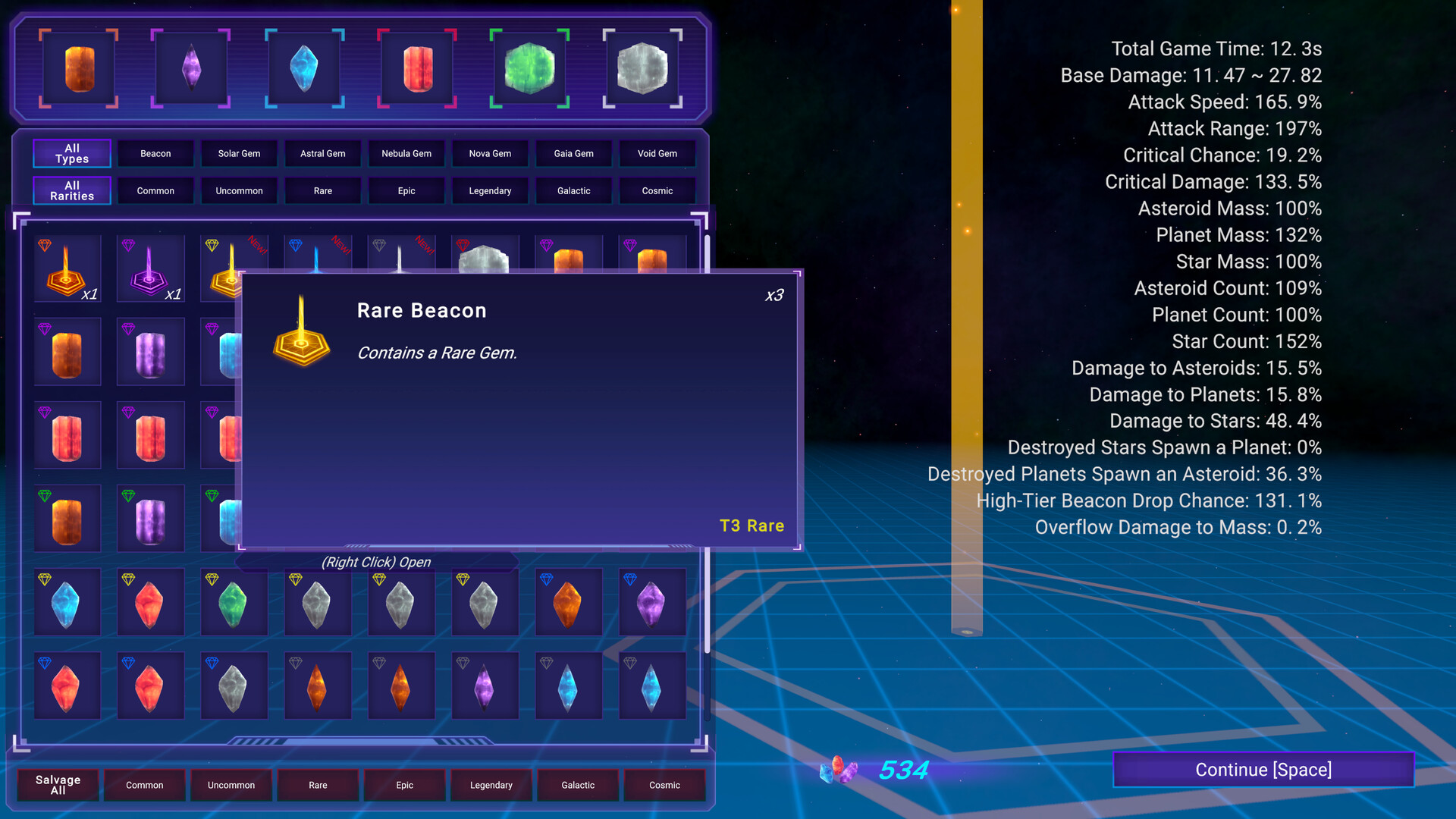
After each run, you open your collected beacons in the main menu and receive a random gem. There are six gem types, each corresponding to a specific slot, but unlocking every slot only takes a couple of minutes. Every gem also comes with a random rarity and a selection of perks that affect different stats when equipped.

Every gem improves some stats while reducing others, and the game does a good job highlighting these changes with green and red numbers. Every now and then, though, you’ll get lucky and find a high rarity gem that completely outclasses your current one without any real downsides. I found myself prioritizing gems that increased round duration, damage, and attack speed, although there are plenty of other, more situational bonuses, such as increased damage against specific object types like asteroids, planets, or stars.

If you don’t want a gem, you can salvage it for a resource. To save time, you can also salvage every gem of a selected rarity with a single click. That resource is used to upgrade gems, although you still need a bit of luck to find the highest rarity ones in the first place.

The problem is that the game never really grows beyond this. It stays simple from beginning to end, and after about half an hour, I already had most of the best rarity gems. From that point on, almost every beacon rewarded me with lower rarity gems that I had to open manually before salvaging. Aside from achievements for destroying certain types of objects and getting very lucky with rarity, there isn’t much reason to keep playing unless you’re aiming for a spot at the top of the leaderboards, which are based solely on your black hole level.
2 found helpful Steam ↗

▲ Recommended 13 hrs
A Game About Getting Bigger embraces one of gaming's oldest and most universally satisfying ideas: starting with almost nothing and gradually becoming unstoppable. Developed and published by PcZ Games, the title wastes no time explaining its purpose. Players assume the role of a black hole drifting through the cosmos, consuming everything from small space debris to entire planetary bodies in an endless pursuit of mass and power. It is an uncomplicated concept on paper, but the execution demonstrates that a focused gameplay loop can be remarkably engaging when paired with meaningful progression systems.

At its heart, the game is an incremental roguelite built around short, repeatable sessions. Each run places players in a procedurally structured environment filled with asteroids, satellites, and larger celestial objects waiting to be absorbed. Initially, movement feels restrained, as the black hole is only capable of swallowing smaller targets. However, the pace steadily accelerates as its size increases, creating a satisfying escalation that keeps each session moving forward. There is a distinct sense of momentum as previously intimidating objects become insignificant obstacles, reinforcing the central fantasy of becoming an all-consuming force of nature.

The progression mechanics add more depth than the minimalist presentation initially suggests. Completing runs rewards players with Beacons that contain Gems of varying rarities, which can then be equipped to improve future attempts. These upgrades encourage experimentation by allowing players to tailor their playstyle around different strengths and synergies. Some builds may focus on maximizing growth speed, while others emphasize efficiency or survivability during longer sessions. This permanent progression system ensures that even unsuccessful runs contribute to overall advancement, giving players a reason to continually return for "just one more attempt."

One of the game's greatest strengths is its pacing. Sessions are intentionally brief, making A Game About Getting Bigger an excellent fit for players who enjoy casual experiences that can be picked up and put down at any time. The built-in time limits prevent the gameplay loop from becoming overly passive and encourage strategic decision-making. Every second matters, and choosing whether to pursue smaller, easier targets or risk traveling toward larger objects creates a subtle layer of tension beneath the game's otherwise relaxing atmosphere.

Visually, the game favors simplicity over spectacle, but this decision works to its advantage. The cosmic environments are clean and readable, allowing players to easily identify potential targets even as the screen becomes increasingly busy. Watching countless objects spiral into the center of your black hole remains consistently entertaining, particularly during the later stages of a run when the scale difference between your starting point and final form becomes dramatic. Combined with atmospheric sound design, the experience succeeds in creating a surprisingly calming interpretation of galactic destruction.

The title also deserves recognition for its accessibility and polish. Support for dozens of languages, Steam Cloud functionality, achievements, and online leaderboards demonstrate a level of care that elevates the package beyond a simple indie experiment. Additionally, the modest hardware requirements make it accessible to a wide audience, while the developer's transparency regarding the limited use of AI-generated assets is a welcome detail in today's gaming landscape.

That said, the game's greatest appeal may also be its primary drawback. Its mechanics are intentionally repetitive, and players seeking a narrative-driven experience or extensive gameplay variety may find themselves reaching the limits of its content sooner than expected. A Game About Getting Bigger lives entirely on the satisfaction of progression, and if watching numbers rise and objects disappear into an ever-expanding singularity does not resonate with you, there is little else to fall back on. Fortunately, the game understands its audience and rarely deviates from its core strengths.

Ultimately, A Game About Getting Bigger succeeds because it never overextends itself. PcZ Games delivers a focused, addictive experience that captures the simple joy of becoming absurdly powerful over time. It is a game built around a single idea, executed with confidence and enough progression hooks to keep players engaged long after their first journey through the stars. For fans of incremental titles and roguelite progression systems, it offers an enjoyable and relaxing trip into the depths of space where the only objective is to keep growing.

Rating: 7/10
2 found helpful Steam ↗
▼ Not recommended 0 hrs
Terrible. I don't remember how I stumbled upon this guy's "games" but there's not really a game here. It's extremely barebones, there's nothing to do, and this seems to be a consistent thing across all of this guy's "games". It's vapid, empty, and soulless.

Easiest refund in a long time. You break rocks, get random gems to increase a very small number of stats by a slight amount, then break more rocks. There's nothing else at all. There's not a single thing beyond what the screenshots already show. No long-term progression, no skill trees, literally all you do is mouse over rocks until they break and equip a handful of items that aren't interesting at all to break those rocks a little bit faster.

I thought "oh maybe it'll be alright for a couple bucks" but no, even that is highway robbery for just how little there is.
1 found helpful Steam ↗

Reviews are by Steam users, hosted on Steam.

Latest updates

Posts come from Steam's official announcements feed.

Looking for something to play next? See the best idle games on Steam, ranked by real player counts.

Comments

Log in to leave a comment.

Loading comments…

Developer of this game? Add an IdleDB badge to your site