▲ Recommended
32 hrs
Disclaimer: This game contains unobtainable Steam achievements.
I've been looking for a good busywork title to pour a bunch of time into ever since I finished Potion Craft, and with Alnico Smithery I felt I finally found it - if only for a short while. And, despite Alnico Smithery managing to scratch the same type of itch for me, and doing many things right - it also falls into the same pitfalls Potion Craft does, and is about the same length, meaning you can 100% it in about 30 hours of gameplay with little incentive to replay it.
The semblance to Potion Craft is immediately felt in the artstyle, which depicts minerals and machinery in fairytale-book-type illustrations, and a vivid, foxed-page color palette. I like this aesthetic a lot; it's a big part of what made the games appeal to me. Information is retained through simple shapes, colors, linework; the tutorial is short and straightforward, and you are quickly left to discover things through the various interlocking systems it offers.
Much like Potion Craft, Alnico hinges on the satisfying feeling of seeing raw material through multiple stages of refinement in order to obtain a product to profit off of. In Potion Craft, you collect plants from your garden, grind them into paste, throw them into the cauldron, then mix, bottle, and serve them - while in Alnico Smithery you mine ore, crush it, refine it, dispense it, melt it, combine it into alloy, pour it into ingots, then shape said ingots into a craft you sell.
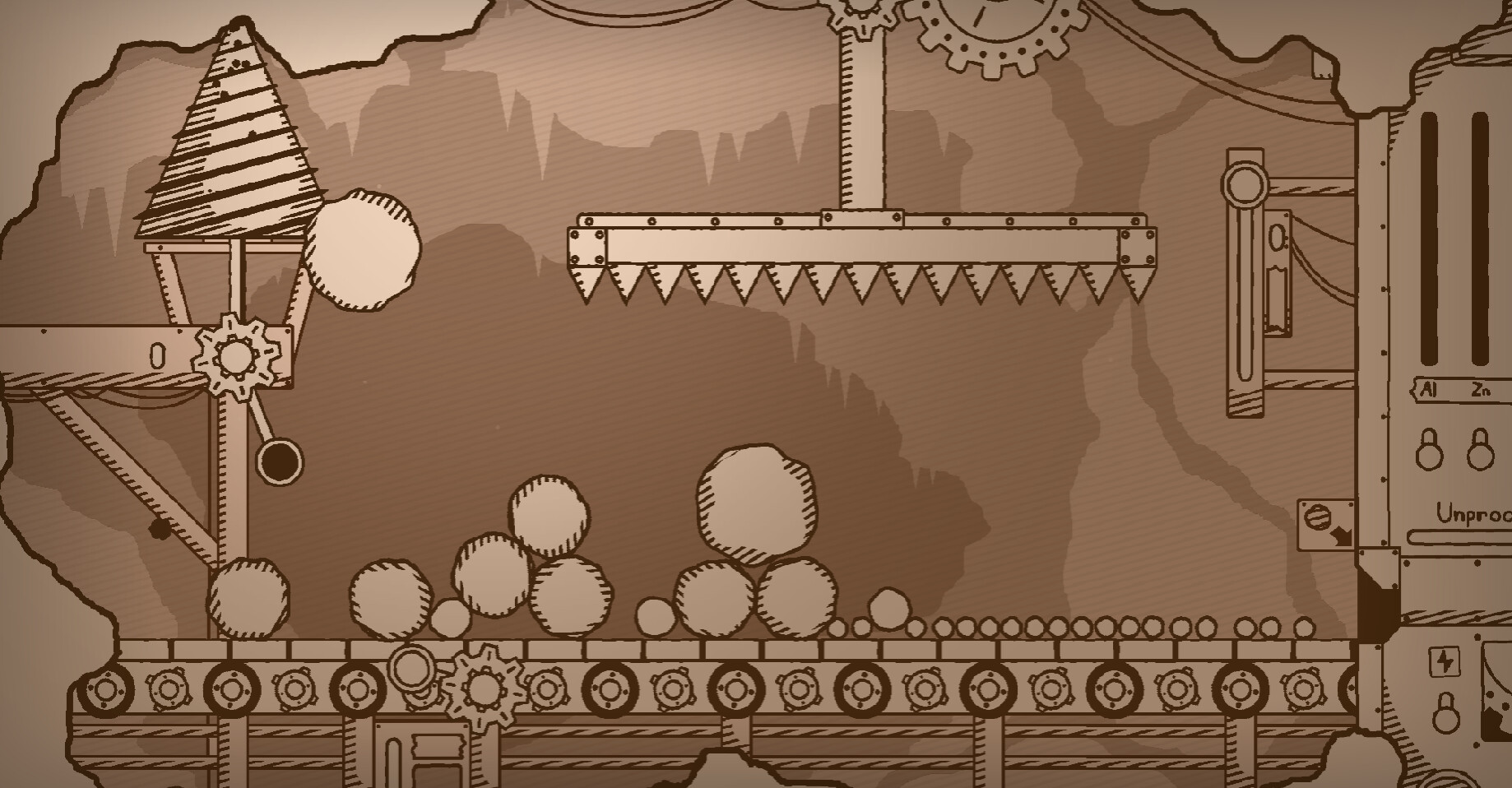
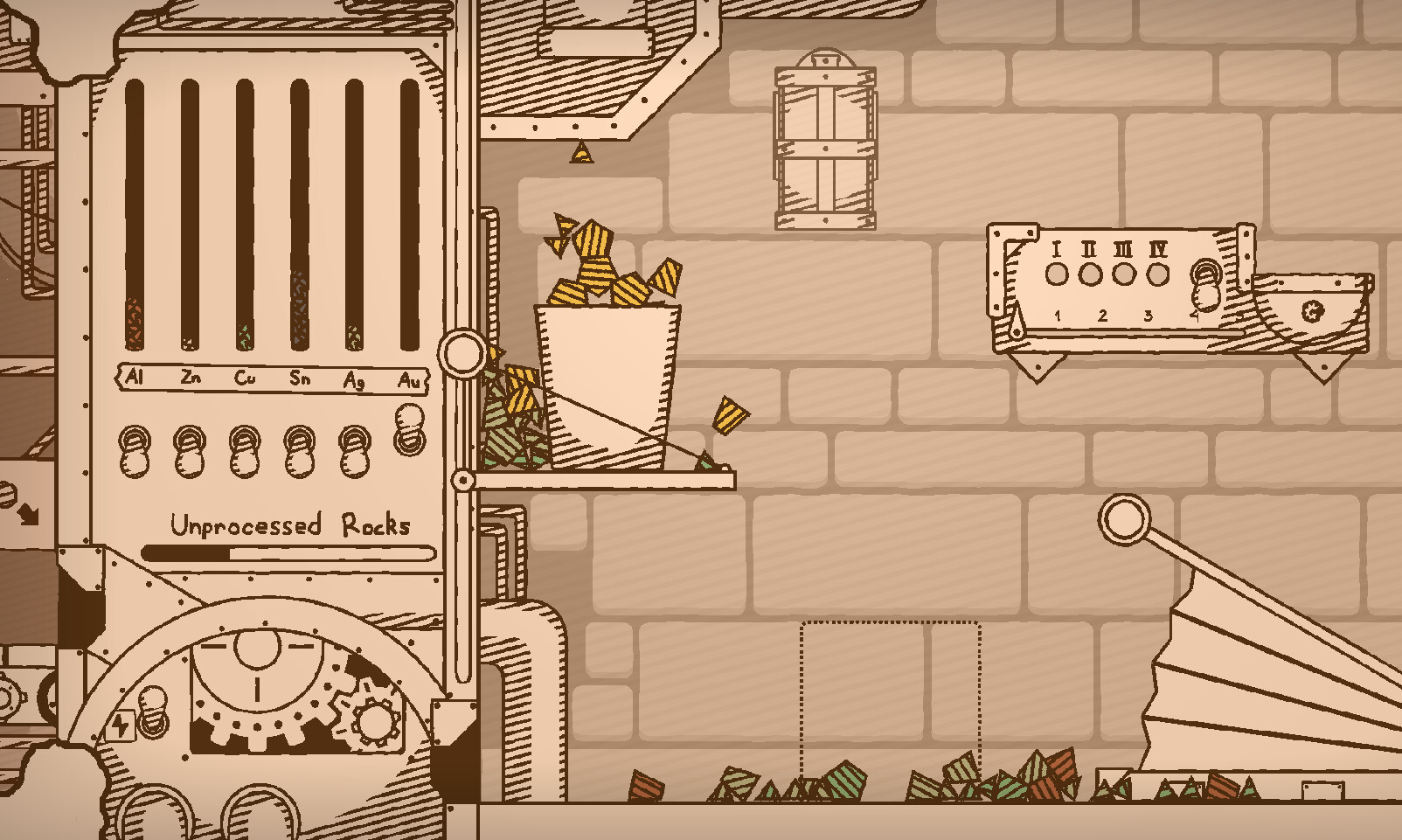
Considering the medieval setting of the game (modern alloys aside), big emphasis is put on menial labor rather than automation. This is something I like, and even prefer. The process begins by mining ore, physically turning a hand crank to drop rocks onto a conveyor belt - that also has to be operated manually. The rocks are then crushed by a crusher so they fit into the refinery snuggly. Each action has an accessibility setting associated with it, ensuring prolonged play is not made straining for the player, which is considerate on the dev's part.
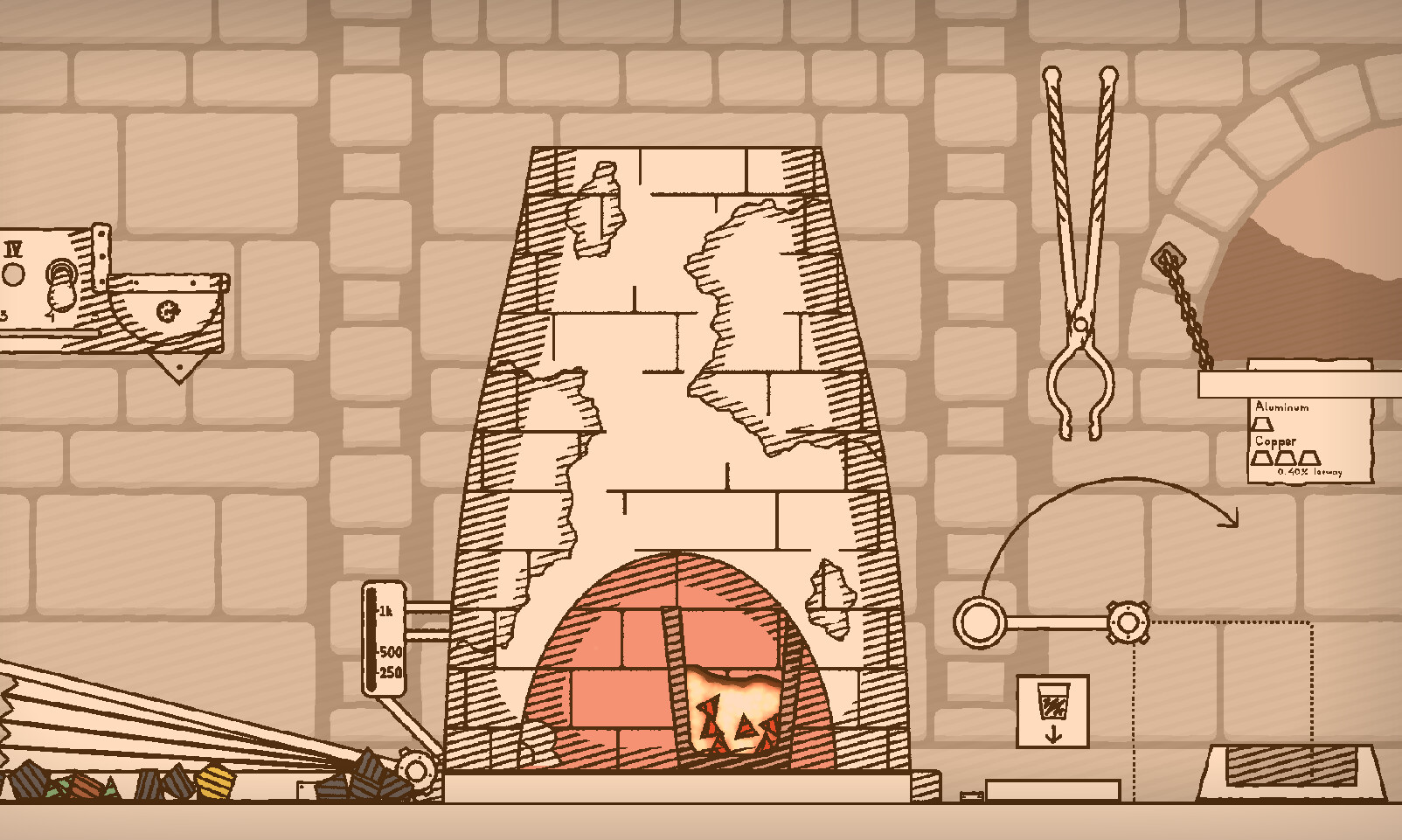
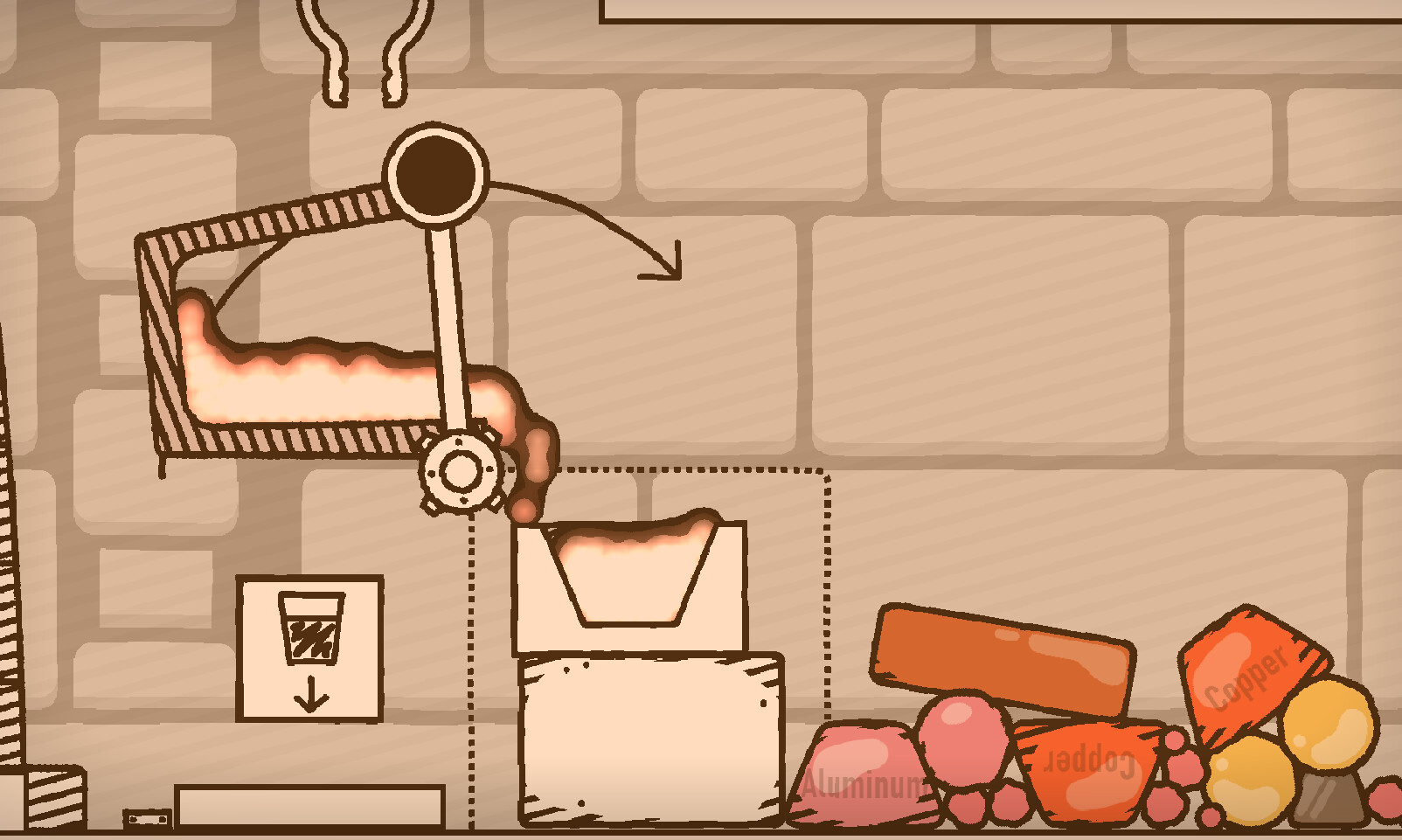
Refined ore is then dispensed onto a crucible the player placed below the chute in advance. This crucible is manually moved to the furnace, which has to be heated up via the bellows repeatedly. It is then moved out of it with a pair of tongs. Spilled ore can be vacuumed back into the refinery using the chute if need be. Molten ore has to be carefully poured into molds set out by the player; in that, the tipper can be used to help do so precisely.
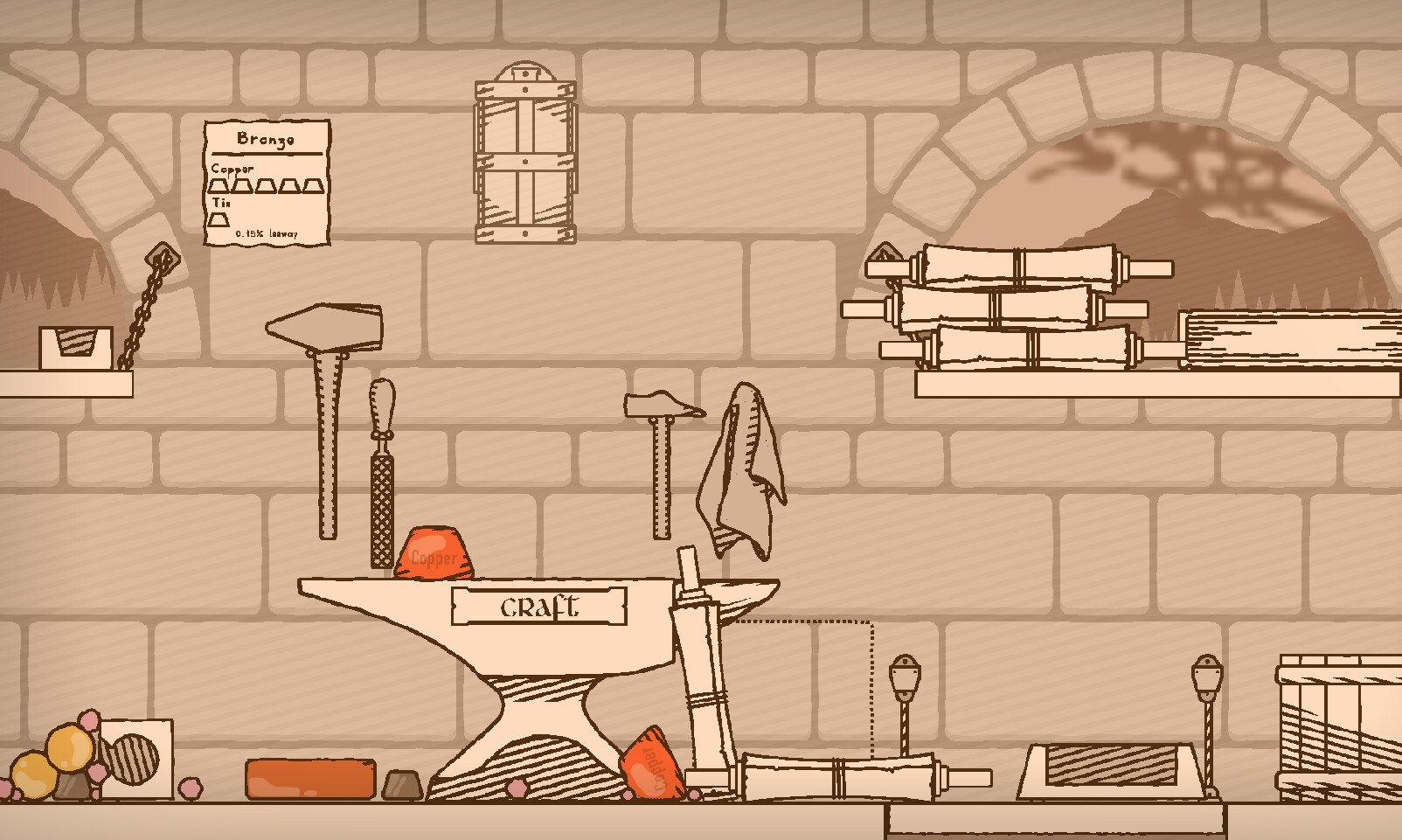
Alloy inside molds cools down into ingots, which have to be placed on the anvil to start the shaping process as they are hot. Shaping is done through a mini-game that tasks players with hitting marks on the ingot precisely. This sequence is not time-sensitive, seeing how the ingots don't cool off on their own; I appreciate this design, as it contributes to the laid-back nature of the game. Missing marks affects the craft's quality, however, and nets you less overall pay.
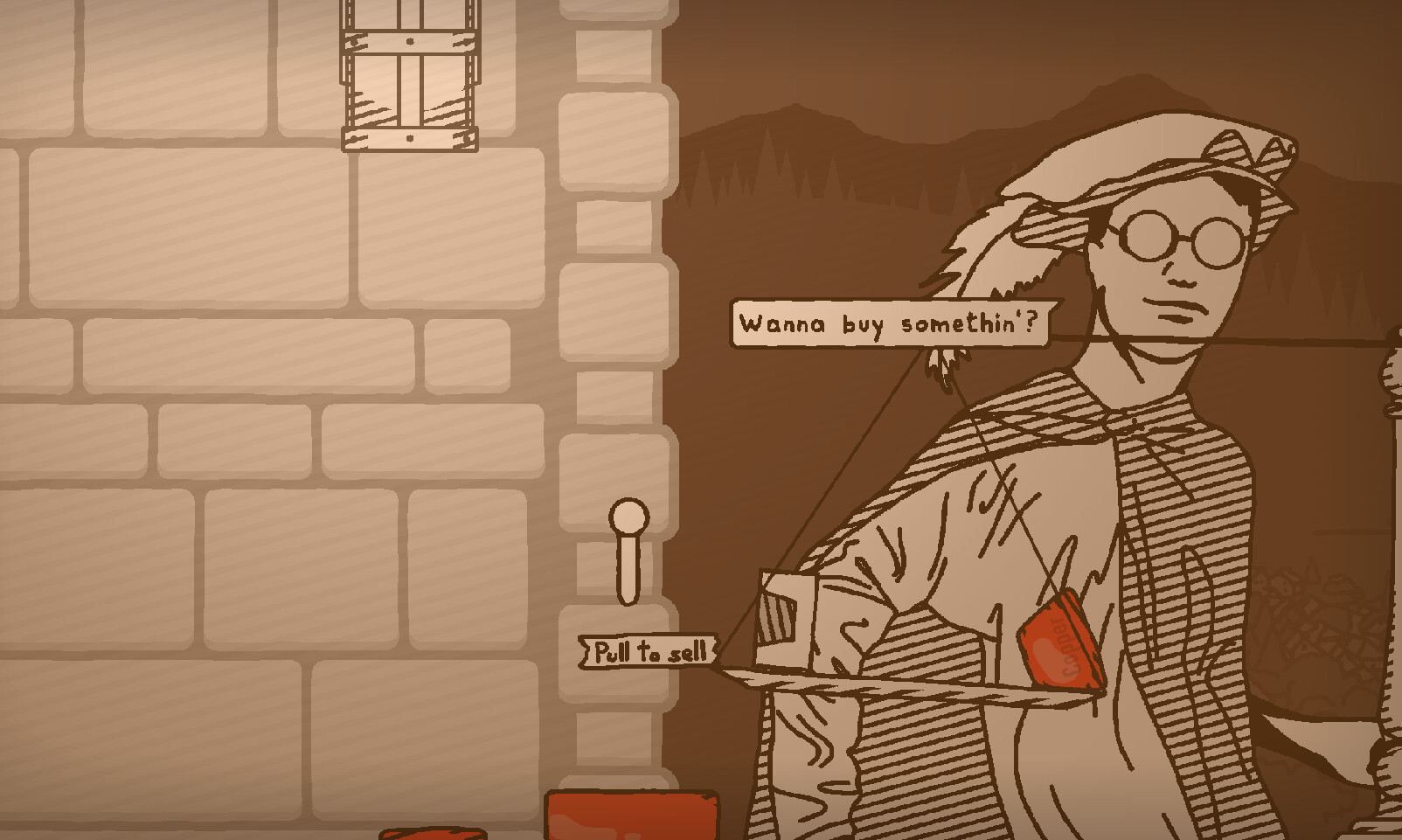
A complete product is then moved onto the scale to be sold for coin. Coins are also physical objects that can be manipulated at will, put into a physical piggy bank or melted down into their base components. The game is chock-full of these cool interactions, like being able to burn orders you don't want to fulfill, turning bugs into carbon, or accidentally melting down household objects. It truly feels like the dev has an eye for detail, which is commendable.
With every task requiring deliberate action on the player's part - dragging ore onto the crucible, tilting it so alloy isn't spilled - one is given ample control over the process. They in turn end up caring more for the outcome. Intent has to be put into portioning ore, moving tools around the workshop, configuring mold setups, shaping ingots with precision. And, as much as this undertaking can be frustrating to some, it was an enjoyable experience for me personally.
The challenge in Alnico Smithery doesn't stem from figuring out how to craft an object, unlike other games; the recipe is already written down in scrolls you receive. Instead, the goal is to figure out how to make the alloy itself. As 3-part (or even 4-part) alloys are introduced, the process becomes more intricate, pushing you to tinker with elements and objects as you try to correct existing ratios, or dispose of failed ones. This fosters a sense of wonder and discovery with the game, filling you with joy if you succeed.
It is possible to deviate from correct alloy ratios by up to 30%; you do not actually need to be precise, to a point where discovery is made impossible, or requires prior metallurgical knowledge. This preemptively eliminates a lot of unnecessary frustration, preventing Alnico from becoming a "wiki game". New alloys are simply discovered when a mixture cools down, and products are discovered when you finally purchase the right molds for them.
Despite every aspect of the game being serviceable, my issue with gameplay (and thus replayability) is rooted in the limited amount of tools offered by it. Drawing parallels to Potion Craft yet again, Alnico suffers from the same issue, where players can only use 1-3 hand tools to manipulate items with - two hammers for hitting marks, and a rag to undo mistakes - then tongs, which is an action that can be forgone by juggling hot objects barehanded.
I would have liked to see more implements - a vat of water or oil to quench items in, a vise or pliers to hold down objects as you shape them, a chisel and mallet to make grooves, punches or drifts to make holes, a file to remove finer amounts of material, a wire brush to clean up scaling, etc. Since interactivity and player involvement are the point of the game, players should have more tools to experiment and attune crafts with.
I would have also liked to see the existing mechanics (and consequently the range of customer asks) expanded; for example, sharpening blades with a grindstone, applying coating, wax, or varnish on products, assembling hilts from pommels and crossguards as well as potential leatherworking / wrapping in the making of the grip (like in Jacksmith), inlaying precious metals or embedding gems, engraving symbols or initials, bartering for item prices, perhaps even "blessing" items. New mini-games would then have to be made to accomodate those.
The lack of aforementioned tools and mechanics hurts the game's longevity, especially as the core loop consists of earning money from products, only to make more products. There are not enough meaningful purchases or upgrades to keep the game entertaining for long. An expanded toolset would have benefitted both the product-making process, and the game's economy. More storage options, as well as display cases for potential pins or rewards for following directions (like in Papers, Please) would be welcome.
It is precisely the vast selection of alloys that keeps players occupied, and I was pleasantly surprised to discover a couple alloys I work with in real life, as well as fantasy alloys with some interesting properties. Towards the endgame, waiting for an order to come through that has an alloy you're missing, can get tedious. I feel there are enough base metals to work with, that the product lineup is satisfactory (despite many products still using placeholder sprites), and that alloy discovery scales well with the purchase of new furnace upgrades.
Seeing a big emphasis put on the physics engine to carry gameplay forward, I have a hunch players looking for more substance will find themselves disappointed. It lacks the potential depth of a full-fledged smithing simulator in its current state. It's certainly one of a kind, a good foundation to build a more complex game upon. I am aware some features I mention in the review are already in the making, however with a sole developer at the helm, and half a year gone by with no major updates, I worry for this project's future.