SKUFS AND ALT-GIRLS is a deliberately unconventional indie title developed and published by Sempiternal Rain that sits somewhere between a life simulation, a narrative experiment, and a piece of internet satire. From the very beginning, the game makes it clear that it is not trying to follow traditional design expectations. Instead, it leans heavily into absurd humor, meme culture, and social parody, presenting a bizarre yet strangely earnest premise in which you play as an “alt-girl” tasked with rehabilitating a “skuf,” a deliberately exaggerated caricature of a socially stagnant, middle-aged man enrolled in a government-style improvement program. The core of the experience revolves around daily care and micromanagement, borrowing loosely from tamagotchi-style mechanics. Players are responsible for maintaining the skuf’s basic needs, such as food, hygiene, and entertainment, while also attempting to nudge him toward marginal self-improvement. These systems are intentionally simple, relying on stats, timers, and menu-driven interactions rather than deep simulation complexity. Progress is measured less by dramatic transformation and more by incremental shifts, reinforcing the game’s satirical tone rather than striving for realism or emotional catharsis. Interwoven with these routine activities are a variety of mini-games and side systems that feel intentionally eclectic. From tank battles to stock market simulations and faux-internet browsing, the game throws in mechanics that often feel disconnected from one another on purpose. This fragmented structure mirrors the chaotic, meme-driven logic of the game’s humor, creating an experience that feels less like a cohesive simulation and more like a collection of absurd vignettes stitched together by a loose narrative framework. Whether this works largely depends on the player’s tolerance for randomness and their appreciation for irony-heavy design. Narrative and writing play a central role in SKUFS AND ALT-GIRLS, often outweighing mechanical interaction. Much of the player’s time is spent reading dialogue, internal monologues, and comedic commentary that satirize internet subcultures, modern relationships, and social stereotypes. The game features multiple alt-girl protagonists, each offering slightly different perspectives and tones, which adds replay value and helps prevent the experience from feeling completely static. The humor is unapologetically niche, drawing heavily from Russian and internet-specific references, which can feel either refreshingly specific or alienating depending on the player’s background. Visually, the game embraces a low-budget, indie aesthetic that prioritizes function and tone over polish. Character art is simple but expressive, often exaggerated to reinforce the comedic intent, while interfaces are utilitarian and sometimes intentionally clunky. Rather than detracting from the experience, this roughness often enhances the game’s identity, making it feel like a piece of outsider art rather than a commercial product aiming for mass appeal. The soundtrack and sound effects further support this vibe, oscillating between understated background noise and deliberately awkward audio cues. Where SKUFS AND ALT-GIRLS becomes most divisive is in its approach to interactivity. For many players, the game feels closer to an interactive novel or satirical e-book than a traditional game, with limited agency and relatively shallow systems. Choices exist, but they rarely lead to dramatically different outcomes, instead shaping tone and flavor rather than structure. Players looking for deep gameplay loops, mechanical mastery, or long-term progression may find the experience lacking, while those more interested in narrative experimentation and humor-driven design may find its minimalism refreshing. Ultimately, SKUFS AND ALT-GIRLS is a game that thrives on being strange, polarizing, and unapologetically niche. It does not aim to please everyone, nor does it attempt to justify itself through conventional design strengths. Instead, it offers a peculiar blend of satire, life-sim parody, and narrative commentary that will resonate strongly with a very specific audience. For players who enjoy experimental indie titles, internet-infused humor, and games that blur the line between storytelling and simulation, it stands as a memorable oddity. For others, it may feel more like a curiosity than a fully realized game, but even then, its willingness to embrace its own weirdness makes it difficult to forget. Rating: 7/10
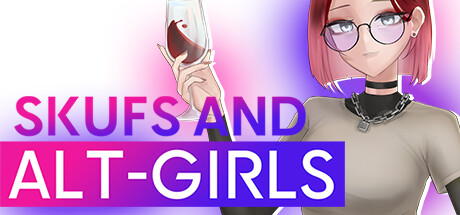
SKUFS AND ALT-GIRLS
by Unknown
What players are saying
Aloha, this is my review for Skufs and Alt-Girls, is a humorous tamogatchi simulator with a twist, you take on the role of an Alt-girl [with new ones unlocked as you play] that is tasked with turning a skuf [a dude with no prospects or hope] in to a productive member of society; bath, feed, clean-up his mess, take him to work, teach him to invest in stocks, while levelling him to do new things like "going to a gym" or "quit smoking" all while increasing his happiness by letting him play games, look at funny Russian memes. The Good: great sense of humor, decent background music, funny Russian memes [the water drop one was so good], funny premise, wacky minigames to play [lizard survivors, sidescoller beer chaser, tank battle], pleasant voice over work, good translation, and did I mention its quite funny? хорошие, хорошие! Also, you have a variety of Alt-girls to play as and fit your style which I liked, and new ones get unlocked as you play, so you can do multiple replays! The Bad: some of the controls are a bit janky [like the jumping in the beer chaser level] but overall, nothing is bad, this is a funny indie game that will make you laugh for the price of a sandwich. The Ugly: абоба
This game is better than it has any right to be. The game is narrated by one voice actor and it is done beautifully (well I don't speak the language but I assume its as good as its sounds to my ear. It could be littered with errors as far as I know). It can get a bit grindy but equally with speed running strats it can be too easy in some ways. There are only two problems with this game, firstly there are no accessability features and as one of the major mechanics used in minigames is button mashing that sadly makes this game inaccessible to those who have issues profforming that action (quite frankly I had a hard time of it sometimes and I don't have issues). The other issue is that each characters storyline is a little too short to become emotionally invested in. Infact it didn't even need to be longer, it just needed a bit more dialogue to give the game more content. This leads to the player slowly trying to speed run later characters and skipping dialogue that is there to get to the end. This game is truely brilliant, and weird. It just is a vibe, but a bit more dialogue would ease the grind and prevent players just trying to blast through the thing. One piece of advice to other English speakers, don't be put off by the amount of non-English in the forum and guide. Just use google translate and its still useful if you get stuck.
Reviews are by Steam users, hosted on Steam.