





▲ Recommended
12 hrs
Songs of Yummy is a cozy yet unexpectedly deep idle simulation developed by DreamStep and FUTU Studio and published by Anotherindie, built around a premise that is equal parts absurd, humorous, and quietly compelling. Set in a world where food scarcity threatens military survival, the game tasks you with solving the problem in the most exaggerated way possible: by turning virtually everything into edible supplies. This tongue-in-cheek framing gives the experience a distinctive personality from the outset, grounding its incremental mechanics in a playful narrative context that helps it stand apart from more abstract idle and clicker games.
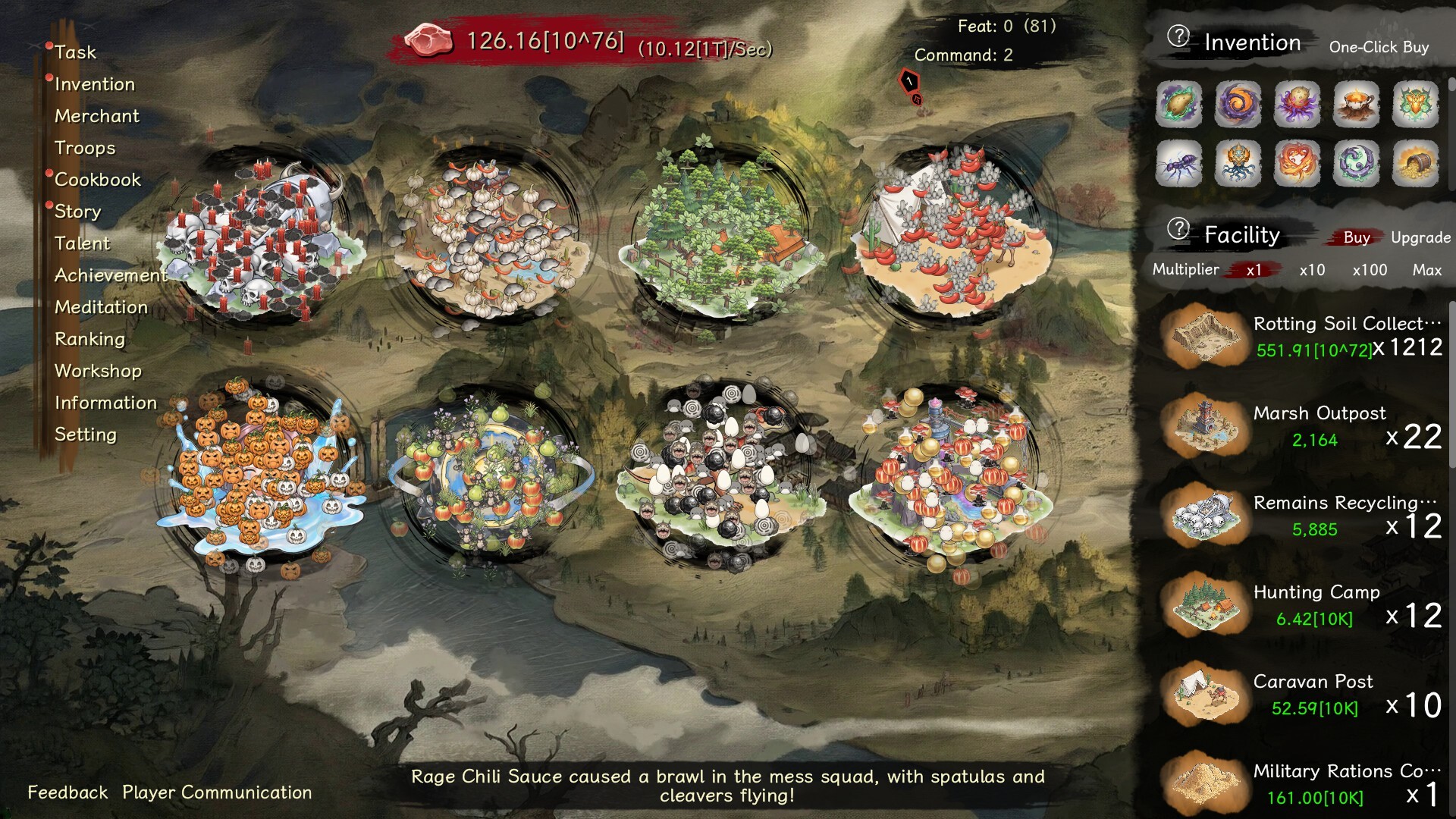
At its core, the game revolves around classic incremental progression. You begin with extremely modest production, manually generating basic food resources and unlocking simple recipes. Over time, these small actions snowball into complex systems of automation, layered recipes, and production chains that feed back into one another. What initially feels like a straightforward idle loop gradually unfolds into a dense web of interlocking mechanics, rewarding players who enjoy optimization and long-term planning. The satisfaction comes not from rapid action but from watching carefully tuned systems grow exponentially, transforming humble beginnings into massive logistical operations.
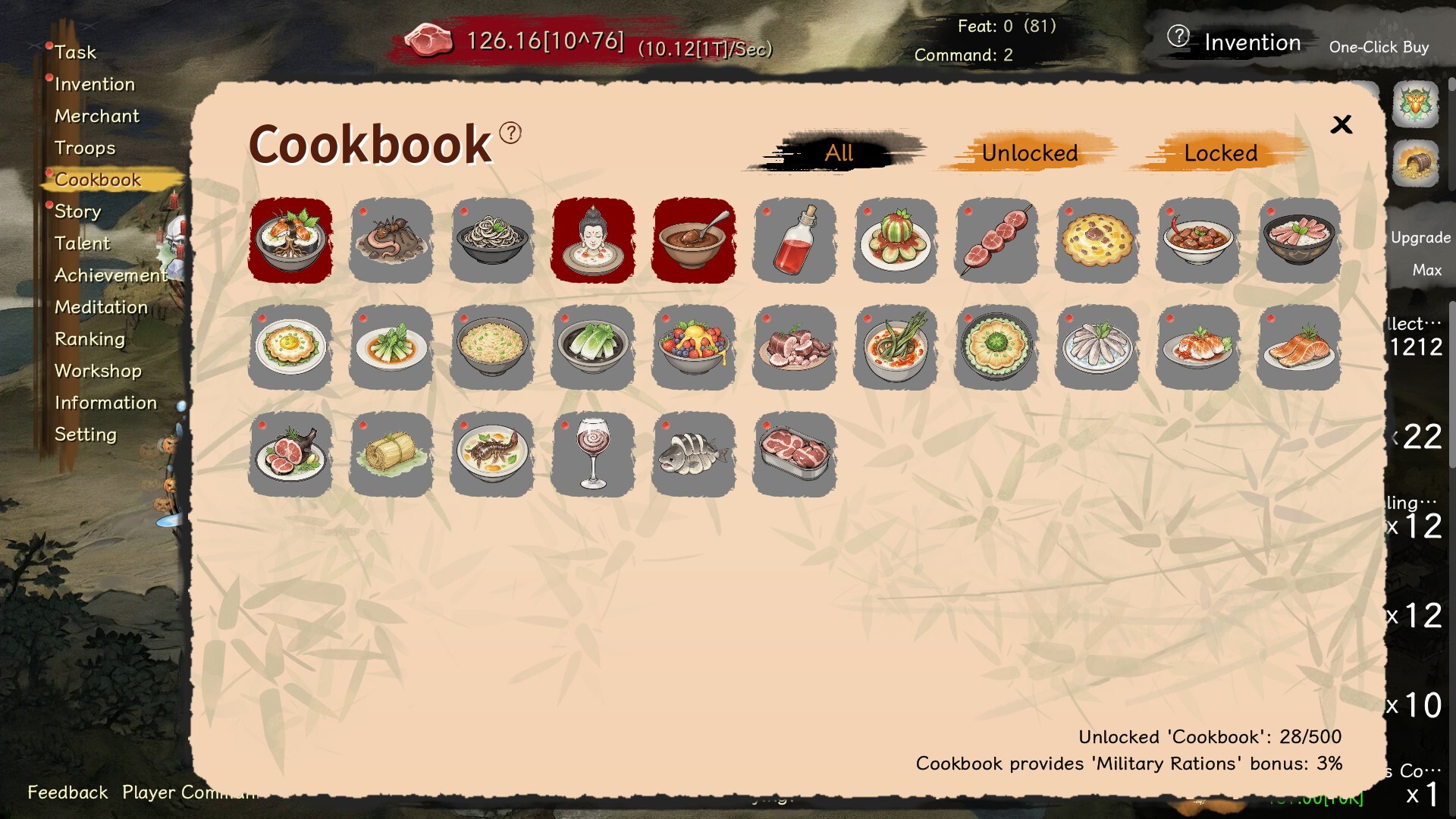
What makes Songs of Yummy especially engaging within the idle genre is how it constantly introduces new mechanics just as older ones begin to feel routine. New recipes, processing methods, and efficiency upgrades steadily expand the scope of play, preventing stagnation and encouraging experimentation. The game frequently nudges players to rethink their approach, whether by reorganizing production priorities or discovering more effective combinations of resources. This sense of discovery gives the progression a strong rhythm, where curiosity drives engagement just as much as numerical growth.
The narrative elements, while light and often humorous, provide a sense of purpose that many idle games lack. Framed around military provisioning and survival, the story offers a strange contrast between its serious backdrop and the cozy, almost whimsical execution. Characters and flavor text lean into surreal humor and exaggerated logic, reinforcing the idea that the game is not meant to be taken literally. Instead, the narrative acts as connective tissue, giving context to the mechanics without ever overwhelming them or demanding constant attention.
Visually, Songs of Yummy adopts a clean and approachable 2D art style that prioritizes clarity over spectacle. Interfaces are designed to communicate large amounts of information efficiently, an essential trait for a game where systems multiply and interact over long play sessions. While the presentation is modest, it complements the game’s relaxed pacing and ensures that even during later stages—when production chains become extensive—the screen never feels cluttered or unreadable. The aesthetic reinforces the game’s cozy tone, making it easy to return to repeatedly without visual fatigue.
From a technical standpoint, the game is intentionally lightweight, designed to run smoothly on a wide range of hardware. This accessibility aligns perfectly with its idle nature, allowing it to function comfortably as a background experience or a long-term project players check in on regularly. The sheer scope of progression means that dedicated players can spend hundreds of hours refining systems, unlocking achievements, and pushing efficiency further, while more casual players can still enjoy steady progress at their own pace.
Ultimately, Songs of Yummy succeeds by embracing what idle games do best while layering in personality, structure, and surprising depth. It doesn’t aim to deliver high-intensity gameplay or dramatic storytelling, but instead offers a comforting loop of growth, experimentation, and gentle humor. For players who enjoy incremental systems, resource management, and games that reward patience and curiosity over reflexes, Songs of Yummy stands as a remarkably engaging and long-lasting experience, proving that even the strangest premises can become deeply satisfying when paired with thoughtful design.
Rating: 6/10
At its core, the game revolves around classic incremental progression. You begin with extremely modest production, manually generating basic food resources and unlocking simple recipes. Over time, these small actions snowball into complex systems of automation, layered recipes, and production chains that feed back into one another. What initially feels like a straightforward idle loop gradually unfolds into a dense web of interlocking mechanics, rewarding players who enjoy optimization and long-term planning. The satisfaction comes not from rapid action but from watching carefully tuned systems grow exponentially, transforming humble beginnings into massive logistical operations.
What makes Songs of Yummy especially engaging within the idle genre is how it constantly introduces new mechanics just as older ones begin to feel routine. New recipes, processing methods, and efficiency upgrades steadily expand the scope of play, preventing stagnation and encouraging experimentation. The game frequently nudges players to rethink their approach, whether by reorganizing production priorities or discovering more effective combinations of resources. This sense of discovery gives the progression a strong rhythm, where curiosity drives engagement just as much as numerical growth.
The narrative elements, while light and often humorous, provide a sense of purpose that many idle games lack. Framed around military provisioning and survival, the story offers a strange contrast between its serious backdrop and the cozy, almost whimsical execution. Characters and flavor text lean into surreal humor and exaggerated logic, reinforcing the idea that the game is not meant to be taken literally. Instead, the narrative acts as connective tissue, giving context to the mechanics without ever overwhelming them or demanding constant attention.
Visually, Songs of Yummy adopts a clean and approachable 2D art style that prioritizes clarity over spectacle. Interfaces are designed to communicate large amounts of information efficiently, an essential trait for a game where systems multiply and interact over long play sessions. While the presentation is modest, it complements the game’s relaxed pacing and ensures that even during later stages—when production chains become extensive—the screen never feels cluttered or unreadable. The aesthetic reinforces the game’s cozy tone, making it easy to return to repeatedly without visual fatigue.
From a technical standpoint, the game is intentionally lightweight, designed to run smoothly on a wide range of hardware. This accessibility aligns perfectly with its idle nature, allowing it to function comfortably as a background experience or a long-term project players check in on regularly. The sheer scope of progression means that dedicated players can spend hundreds of hours refining systems, unlocking achievements, and pushing efficiency further, while more casual players can still enjoy steady progress at their own pace.
Ultimately, Songs of Yummy succeeds by embracing what idle games do best while layering in personality, structure, and surprising depth. It doesn’t aim to deliver high-intensity gameplay or dramatic storytelling, but instead offers a comforting loop of growth, experimentation, and gentle humor. For players who enjoy incremental systems, resource management, and games that reward patience and curiosity over reflexes, Songs of Yummy stands as a remarkably engaging and long-lasting experience, proving that even the strangest premises can become deeply satisfying when paired with thoughtful design.
Rating: 6/10
6 found helpful
Steam ↗




![辩经[Yo_Choice!!!!!]](https://shared.akamai.steamstatic.com/store_item_assets/steam/apps/2806530/05acdd38c231a2451a92c62b9eec35c37ea57924/header.jpg?t=1740938463)