▲ Recommended
1 hrs
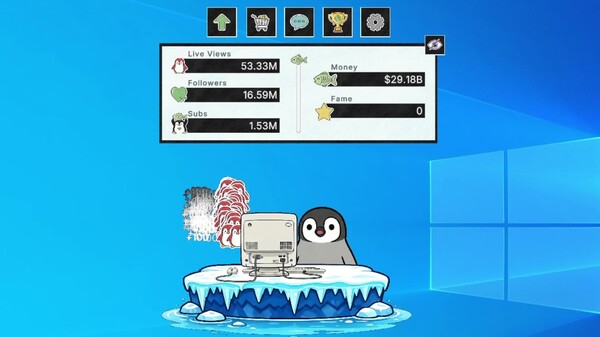
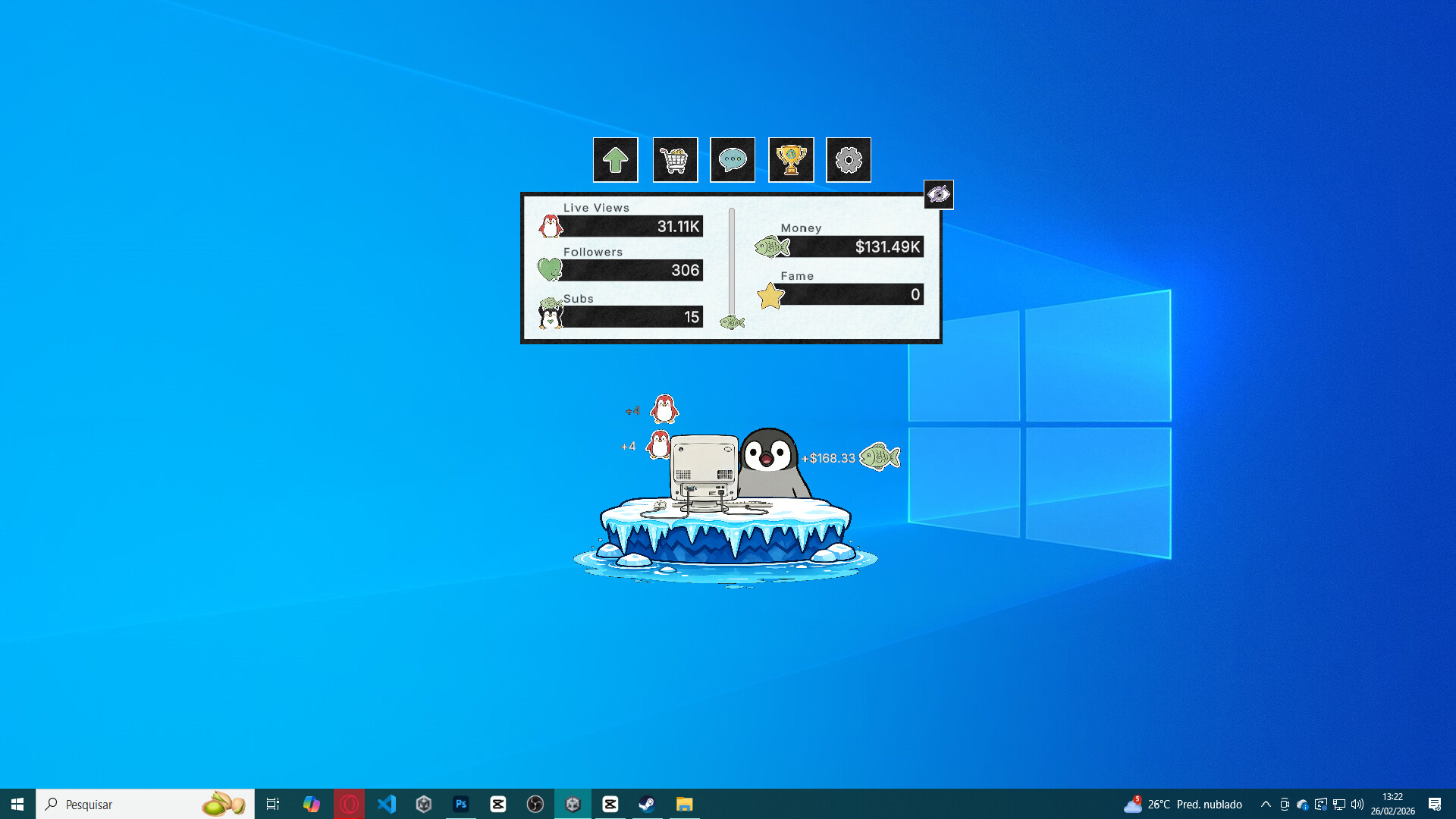
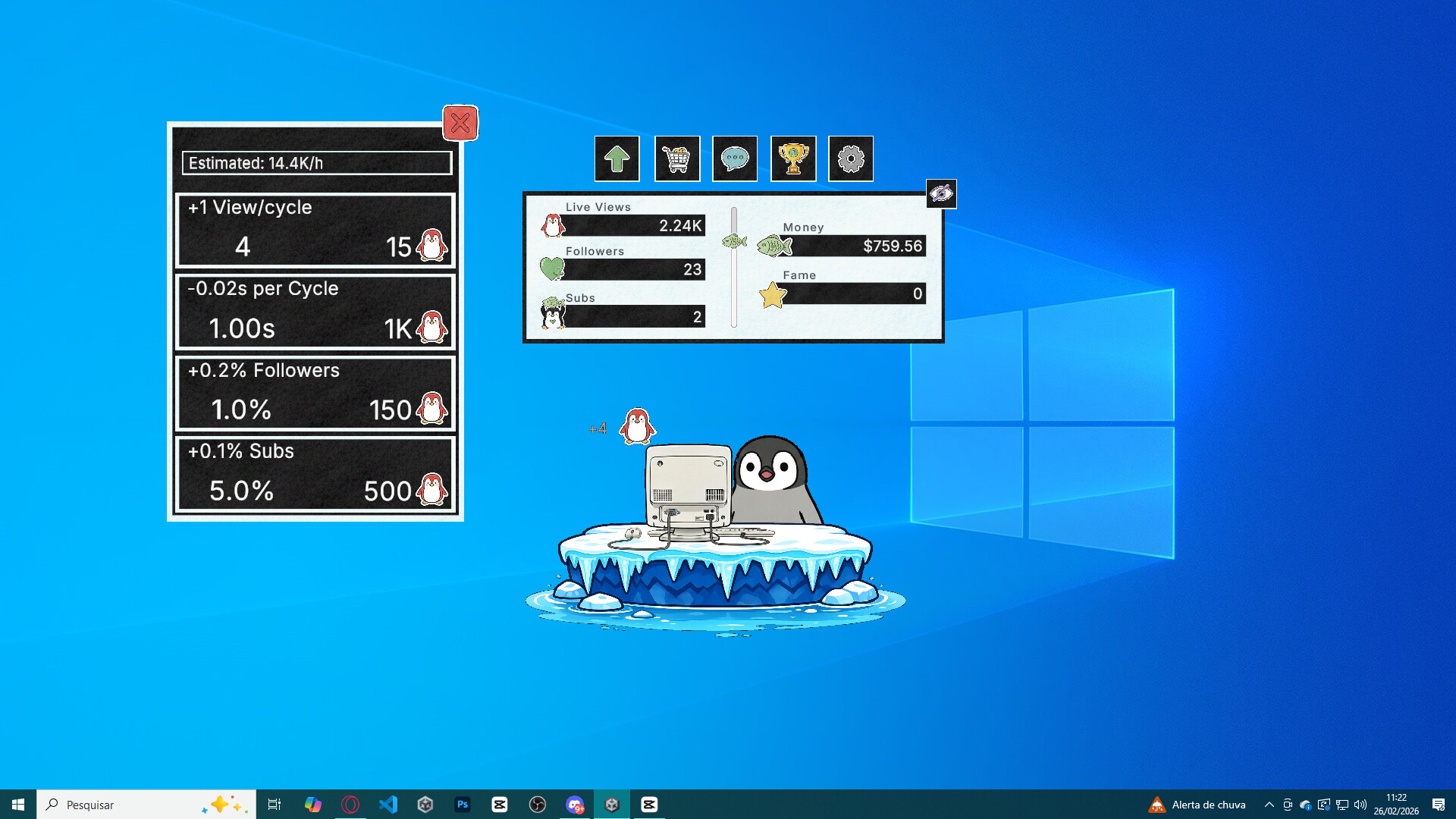
This is a very simple idle game whose main character is a mascot of a well-known game code site. The penguin sits behind a computer and generates views and money each cycle, represented by a fish climbing up a bar. Accumulated views can then be used to boost views per cycle, shorten the cycle time, and increase the chances of viewers following and subscribing, which results in more money per cycle.
Compared to views, money is fairly useless at the beginning. Both views and money can be converted into fame stars that allow you to buy better streaming equipment, but views are much easier to generate and lead to faster stars. For example, the first fame star from views costs 5k, while the first fame star from money requires a small fortune of 50k. Although each star purchase significantly increases the price of the next one, your first few stars will almost certainly come from views.
Fame stars allow you to buy a new monitor, change the appearance of your penguin, or purchase a new logo. Each upgrade grants a percentage bonus to your view and money generation. That is essentially the entire game. Its purpose is to run in the background while you focus on more important work, so progress is intentionally very slow and it takes about an hour before you can afford the first new equipment.
By that point, however, you will probably never run it again. New gear requires even more fame stars, which take increasingly longer to generate. On top of that, you cannot see how equipment affects view and money generation until after you buy it, and purchases happen simply by clicking the equipment icon, with no confirmation window.
▲ Recommended
9 hrs
Kinguin: Become a Streaming Legend presents itself as a quiet, almost understated entry into the idle simulation space, but beneath its simple exterior lies a thoughtfully constructed loop that captures the slow-burn appeal of building something from nothing. Developed and published by Clutch Games, the experience revolves around the familiar fantasy of becoming a successful streamer, yet it approaches that idea with restraint, choosing clarity and accessibility over complexity. Rather than overwhelming the player with systems, it invites them to settle into a steady rhythm of growth that unfolds gradually over time.
At the center of the game is a clean and intuitive progression model that mirrors the lifecycle of an online content creator. You begin with virtually no reach, generating only a trickle of views that can eventually convert into followers and then into subscribers. Each of these stages is tied to probability-based systems that can be improved through upgrades, creating a layered but easy-to-understand funnel of growth. What makes this loop engaging is not its depth but its consistency—every small improvement feels meaningful, and over time, those incremental gains compound into substantial progress. Watching your numbers climb, especially after investing in the right upgrades, delivers a subtle but persistent sense of satisfaction that defines the experience.
The game’s pacing is intentionally relaxed, and that design choice shapes how it fits into a player’s routine. This is not a title that demands constant input or rapid decision-making; instead, it thrives when left running alongside other activities. It encourages brief check-ins rather than extended sessions, making it ideal for multitasking. There’s an almost meditative quality to this approach, as progress continues even when your attention is elsewhere. In a way, the game reflects the culture it’s based on—just as streams often play in the background of daily life, this game becomes a passive companion rather than a demanding focal point.
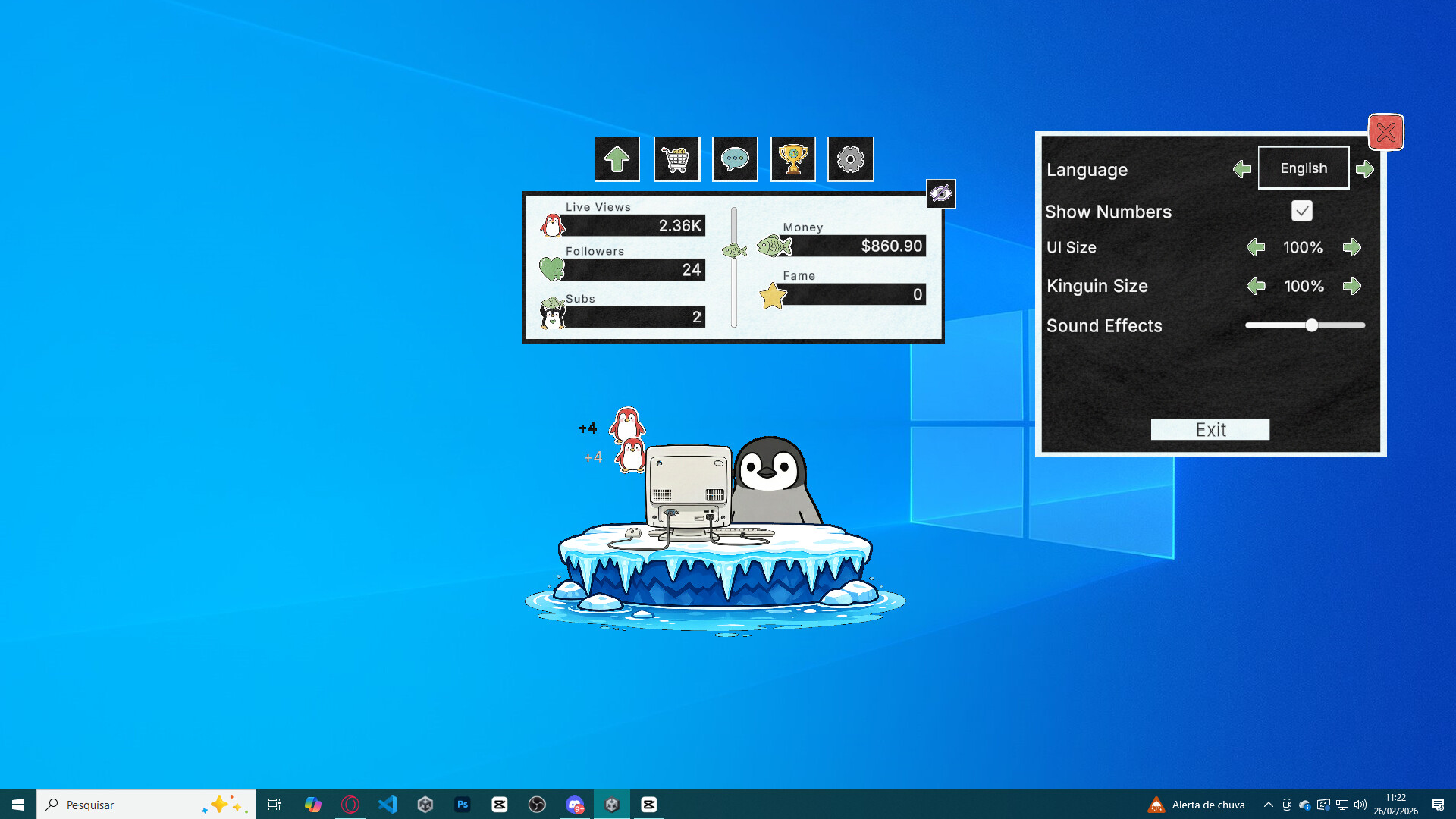
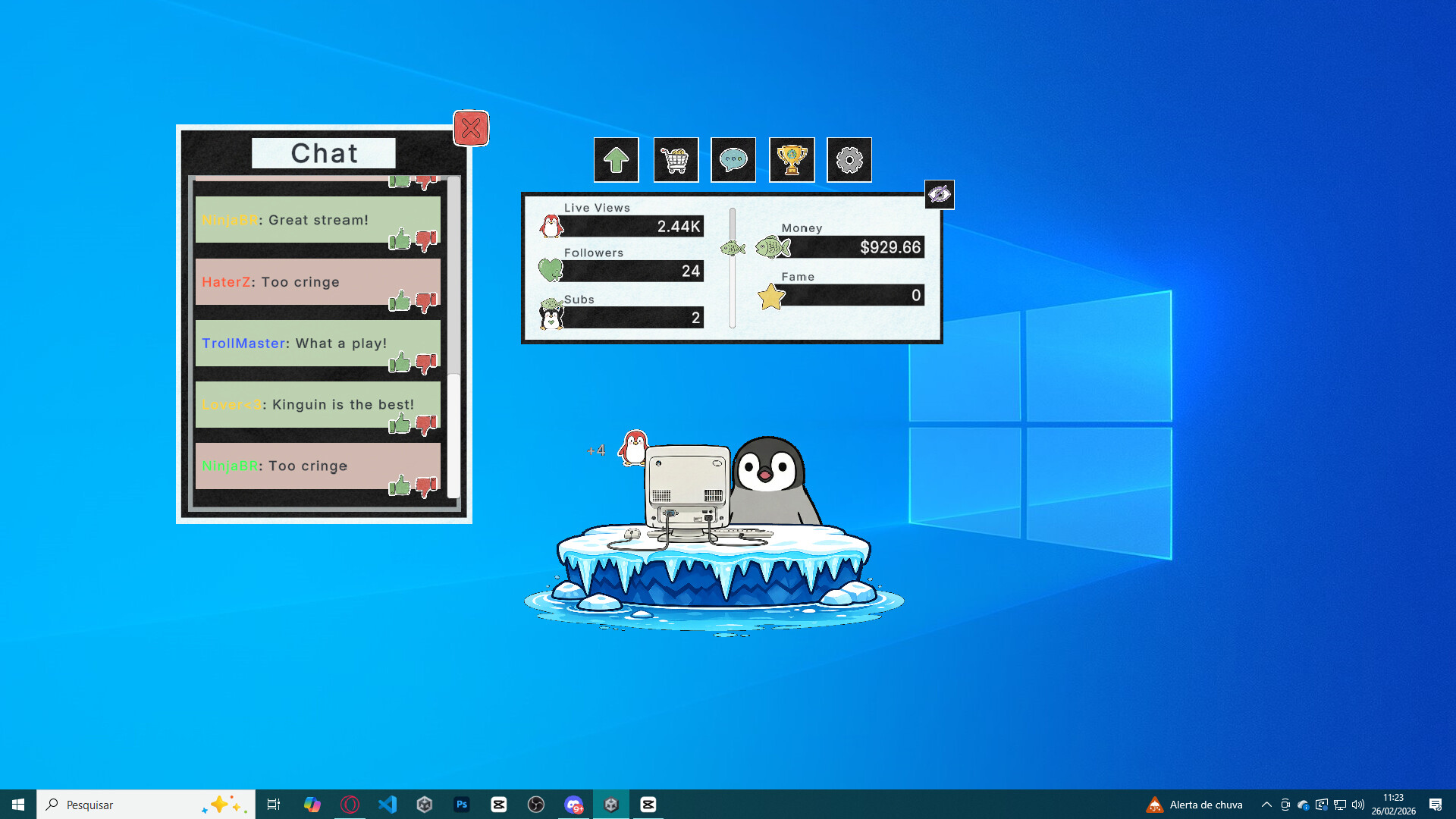
Aesthetically, the presentation leans into a charming and approachable style, centered around its penguin-themed world. The visuals are simple but effective, with a clean interface that prioritizes readability and ease of use. Nothing feels cluttered or overwhelming, which reinforces the game’s overall philosophy of accessibility. The sound design follows a similar path, offering a calm and unobtrusive backdrop that complements the slow pace of progression. While it doesn’t push any technical boundaries, the cohesive presentation helps create a comfortable environment that players can easily return to.
As progression continues, additional features such as global rankings and prestige-style mechanics begin to emerge, offering a sense of longer-term direction. Resetting progress in exchange for permanent bonuses adds a layer of strategy, encouraging players to think about when to optimize their runs for greater efficiency. However, these systems remain relatively straightforward and don’t dramatically alter the core gameplay loop. The experience remains consistent from start to finish, which can be both reassuring and limiting depending on expectations.
That consistency also highlights one of the game’s main drawbacks. While the early stages feel rewarding and engaging, the lack of deeper systems or meaningful variation can lead to a sense of repetition over time. Upgrade paths tend to be linear, and there are few opportunities for creative problem-solving or experimentation. Players who enjoy complex idle games with multiple layers of optimization may find the experience somewhat shallow once the initial novelty fades. It’s a game that prioritizes comfort and simplicity, but that comes at the cost of long-term depth.
Even with those limitations, the game succeeds in delivering a focused and cohesive experience. It understands its role as a low-commitment idle simulator and executes that vision well, offering a steady stream of small rewards that accumulate into satisfying progress. The streaming theme gives it a contemporary edge, while the gentle pacing ensures it remains approachable for a wide range of players. It may not aim to redefine the genre, but it carves out a space for itself as a reliable and relaxing option.
In the end, Kinguin: Become a Streaming Legend is best appreciated as a background experience—something you return to in short bursts, watching your efforts slowly pay off over time. It doesn’t challenge the player in traditional ways, but it provides a consistent sense of forward momentum that can be surprisingly engaging. For those looking for a calm, accessible idle game with a modern theme, it offers a satisfying, if somewhat limited, journey.
Rating: 7/10